MODULE 1 OF 8 · 35 MIN
Orientation & the Virginia Regulatory Framework
Learning objectives
- Identify DPOR and the Board for Contractors and their role in licensing.
- Locate the governing statute (Title 54.1 Ch. 11) and regulation (18 VAC 50-22).
- Explain what the 6-hour pre-license course is (and is not).
Lesson
Welcome — why this course exists
Before Virginia lets you contract for work, the Commonwealth requires one thing of every new licensee that has nothing to do with swinging a hammer: proof that you understand the rules you will be working under. This six-hour pre-license education course is that proof. Over the next eight modules you will learn who regulates contractors in Virginia, what the law requires of you, what conduct can cost you your license, how Virginia protects your customers, and the business fundamentals — contracts, insurance, liens, recordkeeping — that keep a contracting company alive. This first module is your orientation: the regulatory map. Everything in Modules 2 through 7 hangs on the framework you learn here.
DPOR — the agency behind your license
The Department of Professional and Occupational Regulation, or DPOR, is the executive-branch agency that administers occupational licensing in Virginia. DPOR is not just for contractors — it licenses dozens of occupations, from barbers to real estate professionals — but for you it is the agency that will receive your application, issue your license, maintain your record, and, if things go wrong, process complaints against you. When you mail an application, renew a license, or report a change of address, you are dealing with DPOR. Its offices are in Richmond, and its website — dpor.virginia.gov — is the primary source for forms, fee schedules, and current requirements. Bookmark it now: throughout this course, when we say 'verify with the agency,' DPOR's site is where you verify.
The Board for Contractors — who actually writes your rules
Inside DPOR's structure sits the Board for Contractors. The Board is a citizen body — its members include licensed contractors and public members — and it holds the real regulatory power over your trade: it writes the regulations you must follow, sets entry requirements and license classifications, approves education providers, and disciplines licensees who violate the rules. DPOR is the administrative machine; the Board is the rule-maker and the judge. When this course cites 'the Board,' it means the Board for Contractors. Understanding this split matters practically: administrative questions (Where is my application? What is the fee?) go to DPOR; the substance of what you may and may not do as a contractor comes from the Board's regulations.
Where the rules live — statute and regulation
Two documents govern Virginia contracting, and you should know both by name. First, the statute: Title 54.1 of the Code of Virginia — 'Professions and Occupations' — Chapter 11, which covers contractors. This is the law the General Assembly passed. It creates the Board, defines who must be licensed, and sets the outer boundaries of the licensing program. Second, the regulation: 18 VAC 50-22, the Board for Contractors' rules. Regulations fill in the detail the statute leaves open — license classifications and their thresholds, application and renewal procedures, standards of practice, and prohibited acts. The statute is the skeleton; the regulation is the muscle. Both are public and free to read at law.lis.virginia.gov, Virginia's official law portal. A working contractor does not need to memorize them — but a licensed contractor is presumed to know them, and 'I didn't know the rule' is not a defense in a disciplinary case. In Modules 4 and 5 we will walk through the sections that most often trip contractors up.
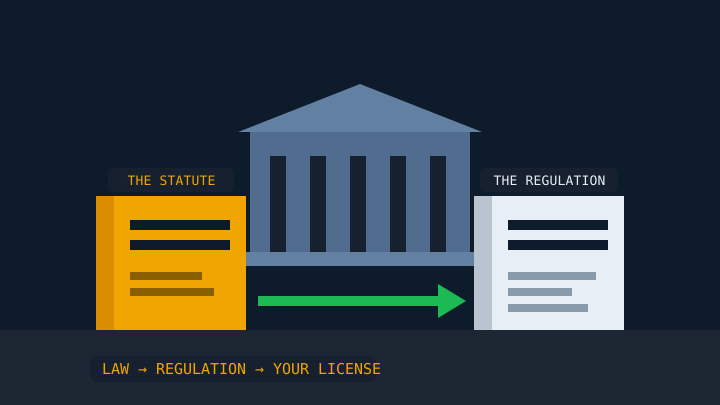
Authority: Va. Code Title 54.1, Ch. 11 · 18 VAC 50-22
Who needs a license — the licensing trigger
Virginia's rule of thumb: if you contract to perform construction, removal, repair, or improvement work and the total value of a single project — labor plus materials — exceeds $1,000, you must hold a Virginia contractor license. Cross that threshold without a license and you are contracting illegally, which carries consequences we cover in Module 5 — including criminal exposure and, just as painful, the possibility of being unable to enforce your contract and collect payment. The licensing system then divides contractors into three classes — A, B, and C — based on the size of projects you take on, each with its own qualifications. Module 2 is devoted entirely to those classes and how to choose the right one for your business.
Authority: Va. Code § 54.1-1100 et seq.
What this course is — and what it is not
Be clear-eyed about what you are completing. This IS the six-hour pre-license education course covering Virginia contractor law, regulations, and basic business principles — a course of instruction new applicants complete before licensure, delivered here as structured online instruction with your time tracked and a completion assessment at the end. It is NOT a license: completing this course does not authorize you to contract; only the Board issues licenses. It is NOT the licensing examination: Class A and B applicants must also pass separate examinations administered through the Board's testing provider — a different requirement with its own preparation. And your instructional time here is measured honestly: the course records your active engagement, module by module, because your completion record is evidence submitted in support of a licensing application. Treat the hours as the point, not an obstacle — the material in this course is the material Virginia holds you responsible for knowing on day one of your license.
How the course works, module by module
Eight modules, 360 minutes of instruction. Module 2 covers license classes and qualifications. Module 3 walks the application, maintenance, and renewal lifecycle. Module 4 covers the Standards of Practice — the conduct rules for licensed contractors. Module 5 covers Prohibited Acts and how to avoid violations. Module 6 covers consumer protection: required contract terms, disclosures, and the Contractor Transaction Recovery Fund. Module 7 covers basic business and law — entity structures, insurance, workers' compensation, liens, and recordkeeping. Module 8 reviews everything and opens your final assessment, which unlocks once every module is complete and the six instructional hours are met. Between modules you will find short reinforcement exercises — use them; completing one credits your instructional time and, more importantly, fixes the material in memory. Ready? Module 2 is where your business decisions start.
Optional deep dive — reading the law like a contractor OPTIONAL
You will never need to recite the regulations, but you will absolutely need to look things up — before you sign an unusual job, when a customer quotes a rule at you, when a form asks something unfamiliar. Here is the skill. Start with the citation format: '18 VAC 50-22-260' reads as Title 18 of the Virginia Administrative Code, agency 50 (the Board for Contractors), chapter 22 (the licensing regulation), section 260. 'Va. Code § 54.1-1115' reads as the Code of Virginia, Title 54.1, section 1115. Statute versus regulation matters when they seem to disagree: the statute is the General Assembly's law and always wins; the regulation implements it. Both live free at law.lis.virginia.gov — no subscription, no middleman, and the version there is the current official text, which matters because summaries (including any course, including this one) can lag an amendment. That is why every module here links its authority: the habit worth building is clicking through to the official text whenever a real decision rides on the answer. Five minutes on the portal before an unusual contract is the cheapest legal advice in Virginia.

Authority: 18 VAC 50-22 · Va. Code Title 54.1, Ch. 11
Traducción de cortesía — la versión en inglés es la oficial del curso.
Bienvenida — por qué existe este curso
Antes de que Virginia le permita contratar obras, el Estado exige a cada nuevo licenciatario algo que no tiene nada que ver con el oficio: demostrar que entiende las reglas bajo las que va a trabajar. Este curso de educación pre-licencia de seis horas es esa demostración. A lo largo de los próximos ocho módulos aprenderá quién regula a los contratistas en Virginia, qué exige la ley, qué conducta puede costarle la licencia, cómo Virginia protege a sus clientes, y los fundamentos de negocio — contratos, seguros, gravámenes, registros — que mantienen viva una empresa de construcción. Este primer módulo es su orientación: el mapa regulatorio. Todo lo que sigue en los Módulos 2 al 7 se apoya en el marco que aprende aquí.
DPOR — la agencia detrás de su licencia
El Departamento de Regulación Profesional y Ocupacional, o DPOR, es la agencia del poder ejecutivo que administra las licencias ocupacionales en Virginia. DPOR no es solo para contratistas — otorga licencias a docenas de ocupaciones — pero para usted es la agencia que recibirá su solicitud, emitirá su licencia, mantendrá su expediente y, si algo sale mal, procesará las quejas en su contra. Cuando envía una solicitud, renueva una licencia o reporta un cambio de dirección, está tratando con DPOR. Sus oficinas están en Richmond, y su sitio web — dpor.virginia.gov — es la fuente primaria de formularios, tarifas y requisitos vigentes. Guárdelo ahora: a lo largo de este curso, cuando decimos 'verifique con la agencia', el sitio de DPOR es donde se verifica.
La Junta de Contratistas — quién escribe realmente sus reglas
Dentro de la estructura de DPOR está la Junta de Contratistas (Board for Contractors). La Junta es un órgano ciudadano — incluye contratistas licenciados y miembros del público — y posee el verdadero poder regulatorio sobre su oficio: escribe los reglamentos que usted debe seguir, fija los requisitos de entrada y las clasificaciones de licencia, aprueba a los proveedores de educación y disciplina a los licenciatarios que violan las reglas. DPOR es la máquina administrativa; la Junta es quien legisla y juzga. En la práctica: las preguntas administrativas (¿Dónde está mi solicitud? ¿Cuál es la tarifa?) van a DPOR; el contenido de lo que usted puede y no puede hacer como contratista proviene de los reglamentos de la Junta.
Dónde viven las reglas — estatuto y reglamento
Dos documentos rigen la contratación en Virginia, y usted debe conocer ambos por su nombre. Primero, el estatuto: el Título 54.1 del Código de Virginia — 'Profesiones y Ocupaciones' — Capítulo 11, que cubre a los contratistas. Es la ley aprobada por la Asamblea General. Crea la Junta, define quién debe tener licencia y fija los límites del programa. Segundo, el reglamento: 18 VAC 50-22, las reglas de la Junta de Contratistas. Los reglamentos detallan lo que el estatuto deja abierto — clasificaciones de licencia y sus umbrales, procedimientos de solicitud y renovación, normas de práctica y actos prohibidos. El estatuto es el esqueleto; el reglamento es el músculo. Ambos son públicos y gratuitos en law.lis.virginia.gov. Un contratista no necesita memorizarlos — pero se presume que un contratista licenciado los conoce, y 'no conocía la regla' no es defensa en un caso disciplinario. En los Módulos 4 y 5 recorreremos las secciones que más problemas causan.
Quién necesita licencia — el umbral de licenciamiento
La regla general de Virginia: si usted contrata para realizar trabajos de construcción, remoción, reparación o mejora y el valor total de un solo proyecto — mano de obra más materiales — supera los $1,000, debe poseer una licencia de contratista de Virginia. Cruzar ese umbral sin licencia es contratar ilegalmente, con consecuencias que cubrimos en el Módulo 5 — incluida exposición penal y, igual de doloroso, la posibilidad de no poder hacer valer su contrato y cobrar. El sistema divide después a los contratistas en tres clases — A, B y C — según el tamaño de los proyectos, cada una con sus propios requisitos. El Módulo 2 está dedicado por completo a esas clases.
Qué es este curso — y qué no es
Sea claro sobre lo que está completando. Esto SÍ es el curso de educación pre-licencia de seis horas que cubre la ley de contratistas de Virginia, los reglamentos y los principios básicos de negocio — instrucción estructurada en línea con su tiempo registrado y una evaluación de finalización al final. NO es una licencia: completar este curso no lo autoriza a contratar; solo la Junta emite licencias. NO es el examen de licencia: los solicitantes de Clase A y B también deben aprobar exámenes separados administrados por el proveedor de exámenes de la Junta. Y su tiempo de instrucción aquí se mide con honestidad: el curso registra su participación activa, módulo por módulo, porque su registro de finalización es evidencia presentada en apoyo de una solicitud de licencia. Trate las horas como el objetivo, no como un obstáculo.
Cómo funciona el curso, módulo por módulo
Ocho módulos, 360 minutos de instrucción. El Módulo 2 cubre las clases de licencia y los requisitos. El Módulo 3 recorre el ciclo de solicitud, mantenimiento y renovación. El Módulo 4 cubre las Normas de Práctica. El Módulo 5 cubre los Actos Prohibidos y cómo evitar infracciones. El Módulo 6 cubre la protección al consumidor: términos de contrato obligatorios, divulgaciones y el Fondo de Recuperación. El Módulo 7 cubre negocio y derecho básicos — estructuras de entidad, seguros, compensación laboral, gravámenes y registros. El Módulo 8 repasa todo y abre su evaluación final, que se desbloquea al completar todos los módulos y las seis horas. Entre módulos encontrará ejercicios cortos de refuerzo — úselos; completar uno acredita su tiempo de instrucción y fija el material en la memoria. ¿Listo? El Módulo 2 es donde empiezan sus decisiones de negocio.
Profundización opcional — leer la ley como un contratista
Nunca necesitará recitar los reglamentos, pero sin duda necesitará consultarlos — antes de firmar un trabajo inusual, cuando un cliente le cite una regla, cuando un formulario le pregunte algo desconocido. Aquí está la destreza. Empiece por el formato de la cita: «18 VAC 50-22-260» se lee como Título 18 del Virginia Administrative Code, agencia 50 (la Junta de Contratistas), capítulo 22 (el reglamento de licencias), sección 260. «Va. Code § 54.1-1115» se lee como el Code of Virginia, Título 54.1, sección 1115. La diferencia entre ley y reglamento importa cuando parecen contradecirse: la ley es la norma de la Asamblea General y siempre gana; el reglamento la implementa. Ambos están gratis en law.lis.virginia.gov — sin suscripción, sin intermediario, y la versión que está ahí es el texto oficial vigente, lo cual importa porque los resúmenes (incluido cualquier curso, incluido este) pueden quedarse atrás de una enmienda. Por eso cada módulo de aquí enlaza su autoridad: el hábito que vale la pena construir es hacer clic hasta el texto oficial cada vez que una decisión real dependa de la respuesta. Cinco minutos en el portal antes de un contrato inusual son la asesoría legal más barata de Virginia.
Authority & state references
- Va. Code Title 54.1, Ch. 11 — Contractors (Code of Virginia, Title 54.1, Chapter 11)
- 18 VAC 50-22 — Board for Contractors Regulations (full chapter)
- § 54.1-1100 — Definitions
Official text opens on the Virginia Law Portal (law.lis.virginia.gov).
REINFORCE IT — COUNTS TOWARD YOUR 6 HOURS
Lock in this module with a quick round — fresh puzzles daily. Completing a game here credits 15 minutes toward your instructional time (once per game per day). Launch the games from this button so the credit counts.
Independent contractor-education provider. Not affiliated with, endorsed by, or acting for the Virginia Board for Contractors or DPOR. GC Prep does not issue or grant a contractor license. Verify all requirements with DPOR.