MODULE 2 OF 8 · 45 MIN
License Classes & Qualifications (Class A / B / C)
Learning objectives
- Distinguish Class A, B, and C by monetary limits and scope.
- Explain the qualified individual / responsible management / designated employee roles.
- Identify specialty designations and when each applies.
Lesson
Three classes, one decision
Virginia divides contractor licenses into three classes — A, B, and C — and choosing between them is one of the first real business decisions you will make, because the class you hold controls the size of the projects you may lawfully take. Understand what that means in practice: the ceiling is not a suggestion, a guideline, or a number the Board only checks when something goes wrong. Take a job above your class ceiling and you are, for that project, an unlicensed contractor — with every consequence Module 5 covers, from discipline to the very real possibility of being unable to enforce the contract and collect what you are owed. The wrong choice costs in both directions. Choose too low and you will spend the year declining work you could have won, or — worse — rationalizing your way into jobs you cannot lawfully hold. Choose too high and you take on qualification requirements, financial showings, and examinations you may not be ready to meet, delaying the license that would already cover the work you actually have. So before you read another word, do the exercise that makes the rest of this module concrete: write down the jobs you realistically expect to bid in the next twelve months, with honest dollar totals — labor plus materials, the way the Commonwealth counts. That list, not ambition, is what should pick your class. As you walk the three classes below, keep the list in front of you: the right class is the one that matches the work you actually intend to win, not the biggest one you might qualify for someday.
Class C — the entry class
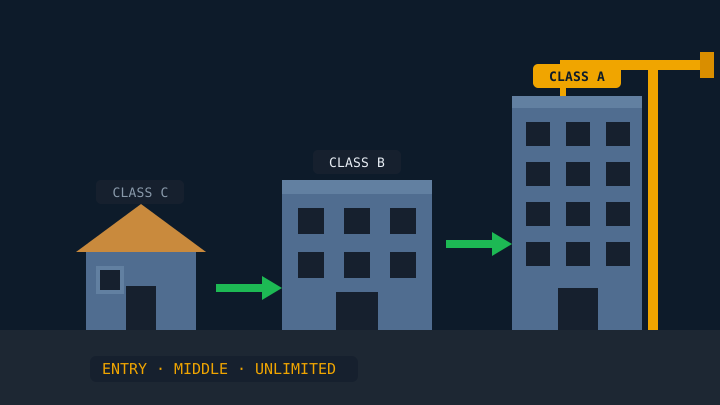
Class C is Virginia's entry-level contractor license, and it authorizes projects up to $30,000 per project (raised from $10,000 by the 2025 amendments to Va. Code § 54.1-1100, effective September 1, 2025), with a 12-month aggregate under $250,000. Hold that number next to the licensing floor from Module 1 — any project over $1,000 requires a license — and you can see exactly what Class C is for: it is the class that makes small-job contracting legal. The handyman-scale remodel, the deck repair, the single-trade bathroom refresh, the punch-out subcontract — this is Class C country, and it is where many owner-operators start. Now run the arithmetic the way the Board does, because the ceiling is measured against the project's total value — labor AND materials — not just what you charge for your time. A job with $13,800 of labor and $17,400 of materials is a $31,200 project: over the ceiling, even though neither number alone looks like it. Materials the customer buys directly, allowances, and mid-job additions all deserve the same scrutiny — a $28,400 contract that grows a $2,100 change order is now a $30,500 project, and the moment to catch that is when the change is priced, not when the invoice is written. The qualifications for Class C are the lightest of the three classes, and for Class C applicants this six-hour course is the centerpiece of the education requirement — which is one reason to take the material seriously rather than treat the hours as a meter to run out. The trade-off for light entry is the low ceiling: a single kitchen remodel can outgrow your license mid-design. When you find yourself declining over-ceiling work every month, that is not a frustration — it is a signal. The upgrade path at the end of this module exists for exactly that moment.
Authority: 18 VAC 50-22-40
Class B — the middle class
Class B authorizes projects from $30,000 up to but not including $150,000 per project, with a 12-month aggregate of $250,000 up to $1 million (per Va. Code § 54.1-1100 as amended effective September 1, 2025), and it is the class where contracting stops being a side operation and becomes a firm. This is the home of the established residential and light-commercial contractor: full kitchen and bath renovations, additions, roofing contracts across a subdivision, serious trade packages on commercial jobs. A $45,000 kitchen, a $70,000 tenant build-out, a $95,000 addition — all comfortably inside Class B, all impossibly beyond Class C. The entry requirements rise to match the exposure. Class B applicants face examination requirements through the Board's testing provider, and the firm must demonstrate financial responsibility appropriate to the class and put qualified people in the roles the next section covers. Treat those requirements as a business-maturity checklist rather than red tape: a firm that can document its finances, name its qualified individual, and pass an examination on Virginia's rules is a firm a customer can safely hand a six-figure deposit — which is precisely the point. One discipline matters more at Class B than anywhere else: bidding near the ceiling. A $147,500 bid against the $150,000 line is technically legal and practically reckless, because the first change order or the contingency you already suspect you will spend pushes the project over the line — and over the line, you are unlicensed for the job. Bid the project's realistic finished value, not its hopeful starting number. If your honest twelve-month list from the top of this module includes routine five-figure and low six-figure work, Class B is usually where you are heading; if the list keeps brushing against $150,000, read the Class A section closely.
Authority: 18 VAC 50-22-50
Class A — the unlimited class
Class A is the top tier. Under Va. Code § 54.1-1100 as amended effective September 1, 2025 (2025 Acts cc. 127, 133), Class A applies when a single contract reaches $150,000 or more, or when your 12-month total reaches $1 million or more — and it carries no upper monetary limit: no per-project cap and no annual cap. A Class A firm can build a garage or a garrison, a kitchen or a campus; the license itself imposes no dollar boundary on the work. That freedom is exactly why the Board asks the most of Class A applicants: the deepest documented experience for the qualified individual, the strongest financial showing, and the most demanding examinations — Class A applicants sit for both the Advanced examination and the Business & Law examination through the Board's testing provider. Notice what the examination pair signals. The Advanced exam says the Commonwealth expects top-tier technical and regulatory command; the Business & Law exam says Virginia knows that what kills large contractors is rarely craft — it is contracts, cash, payroll, and law, the exact material Module 7 covers. If you are completing this course on the way to a Class A license, understand where it fits: this course is the education component of a larger qualification package, not the whole package. Budget your preparation accordingly — the experience documentation and financial records take longer to assemble than the studying does, and Module 3's counsel to order your paperwork before your business cards goes double at this tier. One more planning note: because Class A carries no ceiling, some contractors assume it is simply 'the best' class and reach for it first. Reach instead for the class your next twelve months honestly require. The Board's change-of-class process — covered at the end of this module — means starting at B and earning your way up is a strategy, not a settlement.
Authority: 18 VAC 50-22-60
The people behind the license
A Virginia contractor license is issued to a business entity — but the Board licenses people-in-roles inside that entity, and the vocabulary matters enough to slow down for. Responsible management means the owners and officers who control the firm; the Board looks at their history, their disclosures, and their conduct when it evaluates an application, because a license is ultimately a statement of trust about the humans in charge. The qualified individual is the person whose documented experience in the trade qualifies the firm to perform its classification of work — the technical spine of the license. The designated employee is the member of responsible management or the employee who completes the examination requirements on the firm's behalf for Class A and B licenses. Now watch the roles at work in two firms. In a three-person LLC, the managing partner and the operations partner are responsible management; the field partner with fifteen years of trade history is the qualified individual; and whichever of them sits the exams is the designated employee — three people, four hats, all assigned deliberately and on file with the Board. In a one-person LLC, you are all three: your history is the disclosure, your experience is the qualification, your exam is the examination. Both firms are equally legal. What neither firm may do is leave a hat on the floor: every role must be filled by someone at all times. That is why role changes are license events, not HR events. When the qualified individual resigns, retires, or walks across the street to a competitor, the firm's technical qualification just walked out with them — and as Module 3 covers in detail, the change must be reported to the Board on its clock, not yours. A firm that keeps operating as though nothing happened is running on a license whose premises are no longer true.
Authority: 18 VAC 50-22 (definitions)
Qualifications — what the Board checks
Across all three classes the Board evaluates the same categories, scaled to the class — and knowing the categories in advance turns the application from an interrogation into a checklist. First, experience: the qualified individual's verifiable history in the trade, with more years demanded for higher classes — verify the current figures for your class on DPOR's requirements pages before you apply, because those specifics are the agency's to set and update. Second, financial position appropriate to the class: the Commonwealth wants evidence that the firm holding customer deposits can meet its obligations. Third, education — the requirement this course serves. Fourth, examinations where the class demands them, per the sections above. Fifth, the background and disclosure questions every applicant answers, whatever the class. Two practical habits, drawn from the pattern of real applications, will save you a season each. Habit one: document your experience as you go, starting now. The Board wants verifiable history — dates, employers, project types, references who still answer the phone — and contractors who try to reconstruct a decade of work at application time discover how much of their own history has evaporated. A running one-page work log, updated quarterly, costs minutes and is worth months. Habit two: be scrupulously accurate on the disclosure questions. The pattern Module 5 will make explicit is worth previewing here: the Board routinely works with applicants whose honest histories include judgments, old charges, or prior license issues — context matters and disclosure works. What it does not work with is concealment, because a false statement on an application is itself a prohibited act, separate from and worse than whatever was being hidden. If a question makes you pause, the answer is to disclose and explain — never to hope.
Specialty designations
The class is only half your license. Beyond it, your license carries classifications and specialty designations that define WHAT work you may perform — building, highway/heavy, electrical, plumbing, HVAC, and a long list of specialties. Hold the two dimensions apart, because they answer different questions: the class sets how big; the classification sets what kind. A Class B license with a building classification does not authorize a $30,000 electrical service upgrade — the dollars fit the class, but the work sits outside the classification, and performing work outside your classification is treated like unlicensed work even when your class ceiling would allow the amount. That symmetry surprises contractors constantly, so make the check mechanical: before you bid, confirm BOTH that the project total fits your class ceiling AND that the scope fits your classification. If a job mixes covered and uncovered work — a renovation with a significant plumbing package, say — the uncovered portion belongs to a properly classified contractor, whether that means subcontracting it, partnering, or adding the classification to your own license through the Board's process. When you request classifications at application time, match them to your intended scope honestly: requesting the classification you actually work is free; discovering mid-project that you never held the right one is anything but. The current classification list and definitions live in the Board's regulations and on DPOR's site — bookmark the list next to the fee schedule, and reread your own license's designations once a year; firms drift, and the license should drift with them, deliberately.
Authority: 18 VAC 50-22-20
Choosing well — and moving up
You are not locked in forever — and knowing that should take the anxiety out of choosing. Contractors routinely enter at Class C or B and upgrade as the business grows; the Board has a change-of-class process, and every clean year you run under a lower class builds exactly the record — documented projects, financial history, an unblemished license — that supports the higher one. Upgrading on the strength of a real record is the system working as designed. The expensive mistakes all run in the other direction, and they share a shape: taking tomorrow's work with today's license. The first is the over-ceiling job justified because 'the license upgrade is in process' — it is not in effect, and the project does not wait for the Board's calendar; for that job you are unlicensed, full stop. The second is the split contract: carving one $18,000 project into two $9,000 agreements to duck under a limit. As the deep dive below works through, the split is itself the violation — the Board looks at the project, not the paperwork, and a violation dressed as a workaround is still a violation, now with intent attached. When the too-big job lands in front of you, the honest menu has three items: decline it, team with a contractor whose license covers it, or upgrade first and bid it second. Pick the class your next twelve months of work honestly requires, run clean, document everything, and upgrade on the strength of the record. Module 3 shows you the application and renewal machinery that keeps that license alive.
Optional deep dive — class-limit math, four quotes OPTIONAL
Run the numbers the way the Board would. Quote one: a deck repair — $850 in labor, $600 in materials. Total $1,450: over the $1,000 licensing floor, so a license is required at all; Class C covers it. Quote two: a kitchen remodel priced at $27,900 — inside Class C's $30,000 ceiling, but the customer adds $3,400 of cabinet upgrades mid-job. The project is now $31,300: above the ceiling. The change order that added the work is the moment to catch it — not the final invoice. Quote three: a $146,800 addition for a Class B firm. Inside the $150,000 line, but with $5,000 of contingency likely to be spent, you are pricing a violation with extra steps; bid it honestly or bid it with a Class A partner. Quote four: a $56,000 job offered as two $28,000 contracts to duck under the Class C ceiling — the split is itself the violation, whatever the paperwork says. The pattern in all four: the ceiling is measured against the project's real total — labor plus materials, changes included — and the time to run the math is before signing, because every fix available after signing is worse.

Authority: 18 VAC 50-22-20 · 18 VAC 50-22-40 · 18 VAC 50-22-50 · 18 VAC 50-22-60
Traducción de cortesía — la versión en inglés es la oficial del curso.
Tres clases, una decisión
Virginia divide las licencias de contratista en tres clases — A, B y C — y elegir entre ellas es una de las primeras decisiones de negocio reales que tomará, porque la clase que posea controla el tamaño de los proyectos que puede tomar legalmente. Entienda lo que eso significa en la práctica: el tope no es una sugerencia, una guía, ni un número que la Junta solo revisa cuando algo sale mal. Tome un trabajo por encima del tope de su clase y usted es, para ese proyecto, un contratista sin licencia — con todas las consecuencias que cubre el Módulo 5, desde la disciplina hasta la posibilidad muy real de no poder hacer valer el contrato y cobrar lo que se le debe. La elección equivocada cuesta en ambos sentidos. Elija demasiado bajo y pasará el año rechazando trabajo que podría haber ganado, o — peor — buscando justificaciones para entrar en trabajos que no puede tomar legalmente. Elija demasiado alto y asume requisitos de calificación, demostraciones financieras y exámenes para los que quizá no esté listo, retrasando la licencia que ya cubriría el trabajo que realmente tiene. Así que antes de leer otra palabra, haga el ejercicio que hace concreto el resto de este módulo: anote los trabajos que realistamente espera cotizar en los próximos doce meses, con totales honestos en dólares — mano de obra más materiales, tal como los cuenta el Estado. Esa lista, no la ambición, es lo que debe elegir su clase. Mientras recorre las tres clases a continuación, mantenga la lista delante de usted: la clase correcta es la que corresponde al trabajo que realmente pretende ganar, no la más grande para la que algún día podría calificar.
Clase C — la clase de entrada
La Clase C es la licencia de contratista de nivel de entrada de Virginia, y autoriza proyectos de hasta $30,000 por proyecto (elevado desde $10,000 por las enmiendas de 2025 al Va. Code § 54.1-1100, en vigor el 1 de septiembre de 2025), con un total acumulado de 12 meses por debajo de $250,000. Ponga ese número junto al piso de licenciamiento del Módulo 1 — cualquier proyecto de más de $1,000 requiere una licencia — y verá exactamente para qué sirve la Clase C: es la clase que hace legal la contratación de trabajos pequeños. La remodelación a escala de manitas, la reparación de una terraza, la renovación de un baño de un solo oficio, el subcontrato de detalles finales — este es el territorio de la Clase C, y es donde muchos dueños-operadores comienzan. Ahora haga la aritmética como la hace la Junta, porque el tope se mide contra el valor total del proyecto — mano de obra Y materiales — no solo lo que usted cobra por su tiempo. Un trabajo con $13,800 de mano de obra y $17,400 de materiales es un proyecto de $31,200: por encima del tope, aunque ninguna cifra por sí sola lo parezca. Los materiales que el cliente compra directamente, las asignaciones y las adiciones a mitad del trabajo merecen todos el mismo escrutinio — un contrato de $28,400 que crece con una orden de cambio de $2,100 es ahora un proyecto de $30,500, y el momento de detectarlo es cuando se cotiza el cambio, no cuando se escribe la factura. Los requisitos de la Clase C son los más ligeros de las tres clases, y para los solicitantes de la Clase C este curso de seis horas es la pieza central del requisito de educación — lo cual es una razón para tomar el material en serio en lugar de tratar las horas como un contador que agotar. La contrapartida de una entrada ligera es el tope bajo: una sola remodelación de cocina puede superar su licencia a mitad del diseño. Cuando se encuentre rechazando trabajo por encima del tope cada mes, eso no es una frustración — es una señal. La ruta de ascenso al final de este módulo existe para exactamente ese momento.
Clase B — la clase intermedia
La Clase B autoriza proyectos desde $30,000 hasta, pero sin incluir, $150,000 por proyecto, con un total acumulado de 12 meses de $250,000 hasta $1 millón (según el Va. Code § 54.1-1100 enmendado, en vigor el 1 de septiembre de 2025), y es la clase donde la contratación deja de ser una operación secundaria y se convierte en una empresa. Este es el hogar del contratista residencial y comercial ligero establecido: renovaciones completas de cocina y baño, ampliaciones, contratos de techado a lo largo de un fraccionamiento, paquetes de oficios serios en trabajos comerciales. Una cocina de $45,000, una adecuación de inquilino de $70,000, una ampliación de $95,000 — todo cómodamente dentro de la Clase B, todo imposiblemente fuera del alcance de la Clase C. Los requisitos de entrada suben para igualar la exposición. Los solicitantes de la Clase B enfrentan requisitos de examen a través del proveedor de exámenes de la Junta, y la empresa debe demostrar responsabilidad financiera apropiada para la clase y poner a personas calificadas en los roles que cubre la siguiente sección. Trate esos requisitos como una lista de verificación de madurez del negocio en lugar de trámites burocráticos: una empresa que puede documentar sus finanzas, nombrar a su individuo calificado y aprobar un examen sobre las reglas de Virginia es una empresa a la que un cliente puede entregar con seguridad un depósito de seis cifras — que es precisamente el punto. Una disciplina importa más en la Clase B que en cualquier otro lugar: cotizar cerca del tope. Una cotización de $147,500 contra la línea de $150,000 es técnicamente legal y prácticamente imprudente, porque la primera orden de cambio o la contingencia que ya sospecha que gastará empuja el proyecto por encima de la línea — y por encima de la línea, usted está sin licencia para el trabajo. Cotice el valor final realista del proyecto, no su cifra inicial optimista. Si su lista honesta de doce meses del inicio de este módulo incluye trabajo rutinario de cinco cifras y de seis cifras bajas, la Clase B suele ser hacia donde se dirige; si la lista sigue rozando los $150,000, lea con atención la sección de la Clase A.
Clase A — la clase sin límite
La Clase A es el nivel más alto. Bajo el Va. Code § 54.1-1100 enmendado, en vigor el 1 de septiembre de 2025 (2025 Acts cc. 127, 133), la Clase A aplica cuando un solo contrato alcanza $150,000 o más, o cuando su total de 12 meses alcanza $1 millón o más — y no tiene límite monetario superior: ni tope por proyecto ni tope anual. Una empresa de Clase A puede construir un garaje o una guarnición, una cocina o un campus; la licencia en sí no impone ninguna frontera en dólares sobre el trabajo. Esa libertad es exactamente la razón por la que la Junta exige más de los solicitantes de Clase A: la experiencia documentada más profunda para el individuo calificado, la demostración financiera más sólida y los exámenes más exigentes — los solicitantes de Clase A presentan tanto el examen Avanzado (Advanced) como el examen de Negocio y Derecho (Business & Law) a través del proveedor de exámenes de la Junta. Note lo que señala el par de exámenes. El examen Avanzado dice que el Estado espera un dominio técnico y regulatorio de primer nivel; el examen de Negocio y Derecho dice que Virginia sabe que lo que mata a los grandes contratistas rara vez es el oficio — son los contratos, el efectivo, la nómina y la ley, exactamente el material que cubre el Módulo 7. Si está completando este curso camino a una licencia de Clase A, entienda dónde encaja: este curso es el componente de educación de un paquete de calificación más grande, no el paquete completo. Presupueste su preparación en consecuencia — la documentación de experiencia y los registros financieros tardan más en reunirse que el estudio, y el consejo del Módulo 3 de ordenar su papeleo antes que sus tarjetas de presentación vale doble en este nivel. Una nota más de planificación: como la Clase A no tiene tope, algunos contratistas suponen que es simplemente 'la mejor' clase y la buscan primero. Busque en cambio la clase que sus próximos doce meses honestamente requieren. El proceso de cambio de clase de la Junta — cubierto al final de este módulo — significa que empezar en la B y ganarse el ascenso es una estrategia, no una resignación.
Las personas detrás de la licencia
Una licencia de contratista de Virginia se emite a una entidad de negocio — pero la Junta otorga licencia a personas-en-roles dentro de esa entidad, y el vocabulario importa lo suficiente como para detenerse. La gerencia responsable significa los dueños y directivos que controlan la empresa; la Junta examina su historial, sus divulgaciones y su conducta cuando evalúa una solicitud, porque una licencia es en última instancia una declaración de confianza sobre las personas a cargo. El individuo calificado es la persona cuya experiencia documentada en el oficio califica a la empresa para realizar su clasificación de trabajo — la columna técnica de la licencia. El empleado designado es el miembro de la gerencia responsable o el empleado que completa los requisitos de examen en nombre de la empresa para las licencias de Clase A y B. Ahora observe los roles en funcionamiento en dos empresas. En una LLC de tres personas, el socio administrador y el socio de operaciones son la gerencia responsable; el socio de campo con quince años de historial en el oficio es el individuo calificado; y cualquiera de ellos que presente los exámenes es el empleado designado — tres personas, cuatro sombreros, todos asignados deliberadamente y registrados con la Junta. En una LLC de una sola persona, usted es los tres: su historial es la divulgación, su experiencia es la calificación, su examen es la examinación. Ambas empresas son igualmente legales. Lo que ninguna empresa puede hacer es dejar un sombrero en el suelo: cada rol debe estar ocupado por alguien en todo momento. Por eso los cambios de rol son eventos de licencia, no eventos de recursos humanos. Cuando el individuo calificado renuncia, se jubila o cruza la calle hacia un competidor, la calificación técnica de la empresa acaba de irse con él — y como cubre en detalle el Módulo 3, el cambio debe reportarse a la Junta en el plazo de ella, no en el suyo. Una empresa que sigue operando como si nada hubiera pasado está funcionando con una licencia cuyas premisas ya no son verdaderas.
Requisitos — lo que la Junta verifica
En las tres clases la Junta evalúa las mismas categorías, escaladas a la clase — y conocer las categorías de antemano convierte la solicitud de un interrogatorio en una lista de verificación. Primero, la experiencia: el historial verificable del individuo calificado en el oficio, con más años exigidos para clases más altas — verifique las cifras vigentes para su clase en las páginas de requisitos de DPOR antes de solicitar, porque esos detalles son de la agencia fijarlos y actualizarlos. Segundo, la posición financiera apropiada para la clase: el Estado quiere evidencia de que la empresa que retiene depósitos de clientes puede cumplir sus obligaciones. Tercero, la educación — el requisito que sirve este curso. Cuarto, los exámenes donde la clase los exige, según las secciones anteriores. Quinto, las preguntas de antecedentes y divulgación que responde cada solicitante, sea cual sea la clase. Dos hábitos prácticos, extraídos del patrón de solicitudes reales, le ahorrarán una temporada cada uno. Hábito uno: documente su experiencia sobre la marcha, empezando ahora. La Junta quiere un historial verificable — fechas, empleadores, tipos de proyecto, referencias que todavía contestan el teléfono — y los contratistas que intentan reconstruir una década de trabajo al momento de solicitar descubren cuánto de su propio historial se ha evaporado. Un registro de trabajo continuo de una página, actualizado trimestralmente, cuesta minutos y vale meses. Hábito dos: sea escrupulosamente preciso en las preguntas de divulgación. El patrón que el Módulo 5 hará explícito vale la pena adelantarlo aquí: la Junta trabaja rutinariamente con solicitantes cuyos historiales honestos incluyen fallos judiciales, cargos antiguos o problemas previos de licencia — el contexto importa y la divulgación funciona. Con lo que no funciona es con el ocultamiento, porque una declaración falsa en una solicitud es en sí misma un acto prohibido, separado de y peor que lo que se estuviera ocultando. Si una pregunta lo hace dudar, la respuesta es divulgar y explicar — nunca esperar que pase desapercibido.
Designaciones de especialidad
La clase es solo la mitad de su licencia. Más allá de ella, su licencia lleva clasificaciones y designaciones de especialidad que definen QUÉ trabajo puede realizar — edificación, carreteras/obra pesada, electricidad, plomería, HVAC, y una larga lista de especialidades. Mantenga separadas las dos dimensiones, porque responden preguntas diferentes: la clase fija qué tan grande; la clasificación fija de qué tipo. Una licencia de Clase B con clasificación de edificación no autoriza una actualización de servicio eléctrico de $30,000 — los dólares encajan en la clase, pero el trabajo queda fuera de la clasificación, y realizar trabajo fuera de su clasificación se trata como trabajo sin licencia aun cuando el tope de su clase permitiría el monto. Esa simetría sorprende constantemente a los contratistas, así que haga la verificación mecánica: antes de cotizar, confirme AMBAS cosas: que el total del proyecto encaja en el tope de su clase Y que el alcance encaja en su clasificación. Si un trabajo mezcla trabajo cubierto y no cubierto — una renovación con un paquete de plomería significativo, por ejemplo — la porción no cubierta corresponde a un contratista debidamente clasificado, ya sea subcontratándola, asociándose o añadiendo la clasificación a su propia licencia a través del proceso de la Junta. Cuando solicite clasificaciones al momento de la solicitud, hágalas corresponder honestamente con su alcance previsto: solicitar la clasificación en la que realmente trabaja es gratis; descubrir a mitad del proyecto que nunca tuvo la correcta es cualquier cosa menos gratis. La lista y las definiciones de clasificaciones vigentes viven en los reglamentos de la Junta y en el sitio de DPOR — marque la lista junto a la tabla de tarifas, y relea las designaciones de su propia licencia una vez al año; las empresas cambian, y la licencia debe cambiar con ellas, deliberadamente.
Elegir bien — y ascender
Usted no queda atado para siempre — y saberlo debería quitarle la ansiedad de elegir. Los contratistas rutinariamente entran en la Clase C o B y ascienden a medida que el negocio crece; la Junta tiene un proceso de cambio de clase, y cada año limpio que opera bajo una clase más baja construye exactamente el registro — proyectos documentados, historial financiero, una licencia sin manchas — que respalda la más alta. Ascender con la fuerza de un registro real es el sistema funcionando como fue diseñado. Los errores costosos todos corren en la dirección contraria, y comparten una forma: tomar el trabajo de mañana con la licencia de hoy. El primero es el trabajo por encima del tope justificado porque 'el ascenso de licencia está en trámite' — no está en vigor, y el proyecto no espera el calendario de la Junta; para ese trabajo usted está sin licencia, punto. El segundo es el contrato dividido: fraccionar un proyecto de $18,000 en dos acuerdos de $9,000 para colarse por debajo de un límite. Como trabaja en detalle el análisis a fondo a continuación, la división es en sí misma la infracción — la Junta mira el proyecto, no el papeleo, y una infracción disfrazada de solución alterna sigue siendo una infracción, ahora con intención añadida. Cuando el trabajo demasiado grande aterrice frente a usted, el menú honesto tiene tres opciones: rechazarlo, asociarse con un contratista cuya licencia lo cubra, o ascender primero y cotizarlo después. Elija la clase que sus próximos doce meses de trabajo honestamente requieren, opere limpio, documente todo, y ascienda con la fuerza del registro. El Módulo 3 le muestra la maquinaria de solicitud y renovación que mantiene viva esa licencia.
Análisis a fondo opcional — la matemática del límite de clase, cuatro cotizaciones
Haga los números como los haría la Junta. Cotización uno: la reparación de una terraza — $850 en mano de obra, $600 en materiales. Total $1,450: por encima del piso de licenciamiento de $1,000, así que se requiere una licencia del todo; la Clase C lo cubre. Cotización dos: una remodelación de cocina cotizada en $27,900 — dentro del tope de $30,000 de la Clase C, pero el cliente añade $3,400 de mejoras de gabinetes a mitad del trabajo. El proyecto es ahora de $31,300: por encima del tope. La orden de cambio que añadió el trabajo es el momento de detectarlo — no la factura final. Cotización tres: una ampliación de $146,800 para una empresa de Clase B. Dentro de la línea de $150,000, pero con $5,000 de contingencia que probablemente se gastarán, usted está cotizando una infracción con pasos adicionales; cotícela honestamente o cotícela con un socio de Clase A. Cotización cuatro: un trabajo de $56,000 ofrecido como dos contratos de $28,000 para colarse por debajo del tope de la Clase C — la división es en sí misma la infracción, diga lo que diga el papeleo. El patrón en las cuatro: el tope se mide contra el total real del proyecto — mano de obra más materiales, cambios incluidos — y el momento de hacer la matemática es antes de firmar, porque toda solución disponible después de firmar es peor.
Authority & state references
- 18 VAC 50-22-40 — Requirements for a Class C license
- 18 VAC 50-22-50 — Requirements for a Class B license
- 18 VAC 50-22-60 — Requirements for a Class A license
Official text opens on the Virginia Law Portal (law.lis.virginia.gov).
REINFORCE IT — COUNTS TOWARD YOUR 6 HOURS
Lock in this module with a quick round — fresh puzzles daily. Completing a game here credits 15 minutes toward your instructional time (once per game per day). Launch the games from this button so the credit counts.
Independent contractor-education provider. Not affiliated with, endorsed by, or acting for the Virginia Board for Contractors or DPOR. GC Prep does not issue or grant a contractor license. Verify all requirements with DPOR.