Course outline — 100 minutes across 6 modules
- Why Liens Exist — the Chapter 44A Toolkit · ≈ 17 min
- The Lien Agent: Designation and the $40,000 Threshold · ≈ 17 min
- Information Flows: Who Must Tell Whom, and When · ≈ 16 min
- Perfecting the Claim: 120 Days, the Right Courthouse · ≈ 17 min
- Enforcement, Priority, and the Clock · ≈ 16 min
- Lien Risk Management for the Licensed GC · ≈ 17 min
MODULE 4 OF 6 · ESTIMATED 17 MIN
Perfecting the Claim: 120 Days, the Right Courthouse
Learning objectives
- State the filing deadline for a claim of lien on real property and the event that starts the clock.
- Identify where the claim of lien is filed and the public-notice effect of filing.
- Distinguish the perfection path of the real-property lien from the subcontractor’s notice of claim of lien upon funds.
Lesson
DRAFT — pending instructor-of-record approval
From right to remedy
Everything to this point has been rights and notices. A lien right, though, is only potential energy — it becomes an enforceable encumbrance through PERFECTION: the formal, deadline-bound filing that puts the claim on the public record. North Carolina’s perfection rules are strict, mechanical, and unforgiving of approximation. This module gives you the three coordinates that decide most lien fights: WHAT gets filed, WHERE it gets filed, and — above all — BY WHEN.
The 120-day rule
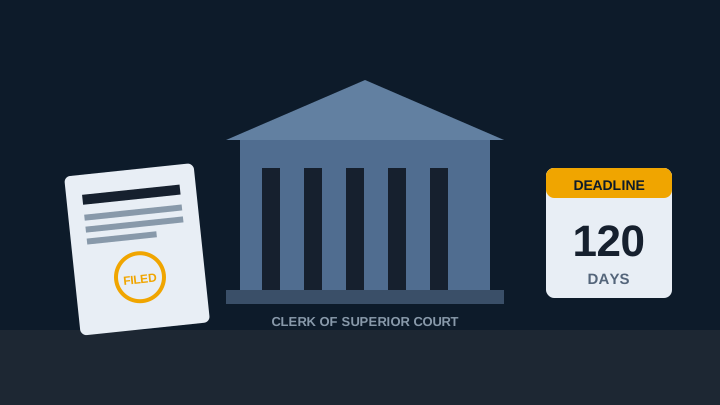
Under § 44A-12, a claim of lien on real property must be filed NOT LATER THAN 120 DAYS AFTER THE LAST FURNISHING of labor or materials at the site by the person claiming the lien. Every word of that sentence has teeth. The clock runs from LAST furnishing — the final date the claimant actually supplied labor or materials to the project — not from the invoice date, not from substantial completion, not from when payment was refused. It is claimant-specific: your last furnishing date and your electrical sub’s last furnishing date are different clocks. And it is a hard perfection deadline: file on day 121 and the real-property lien is gone, whatever the merits of the underlying debt. Run the arithmetic the way the statute does: a supplier whose last delivery hit the site on March 1 must file by late June — 120 calendar days out. Diary the date the moment your scope ends.
Authority: N.C.G.S. § 44A-12
Where, and what it does
The claim of lien on real property is filed in the office of the CLERK OF SUPERIOR COURT in the county where the property is located. Not the register of deeds, not the Board, not the lien agent — the clerk of superior court, in the property’s county; a multi-county project means thinking about each parcel’s county. Filing is what gives the claim its public force: the filed claim of lien is the document that gives public notice of the contractor’s claim against that specific parcel. From filing forward, the lien clouds the title — buyers, lenders, and title insurers will find it and require it to be resolved. That public-notice effect is the entire commercial leverage of a mechanics’ lien: it converts a private payment dispute into a title problem the owner cannot ignore.
Authority: N.C.G.S. § 44A-12
A caution on last furnishing
Because the deadline hangs on last furnishing, that date deserves real discipline in your records. Daily logs, delivery tickets, and timecards showing site activity are what establish it. Two field cautions. First, do not let the date drift late in your assumptions: trivial returns to the site — retrieving tools, a courtesy visit — are the classic overreach when a claimant tries to stretch the window, and relying on them is gambling with perfection. Second, do not let it drift early either: punch-list work under the contract is furnishing. The safe practice is to compute the deadline from the earliest defensible last-furnishing date and file inside it with margin. The 120 days is a maximum, not a target — nothing stops a claimant from filing the week payment first fails.
Authority: N.C.G.S. § 44A-12
The funds-lien path for those below you
Your subcontractors and their suppliers perfect differently. Lacking a contract with the owner, their instrument is the lien upon funds: a NOTICE OF CLAIM OF LIEN UPON FUNDS served on the party or parties above them in the chain — reaching, ultimately, the owner. The notice obligates its recipient with respect to the funds it still holds: money not yet paid down the chain becomes the security. And as module 1 previewed, the statute in defined circumstances subrogates the funds claimant to the general contractor’s own lien on the real property — which is how a supplier three tiers down can end up encumbering the land itself. For you as the GC this is not academic: notices of claim of lien upon funds arrive addressed to YOU, they change what you may safely pay out, and mishandling one converts your payment ledger into the battlefield. Module 6 picks up that management problem.
Authority: N.C.G.S. § 44A-18 · N.C.G.S. § 44A-19 · N.C.G.S. § 44A-23
Worked example — computing the date from the tickets
Perfection math is done from records, not memory. Your project file shows delivery tickets on March 12, March 26, and a final punch-list visit logged April 2 where your crew reset two door closers under the contract. Payment fails in May. Which date starts the clock? April 2 — punch-list work performed under the contract is furnishing, and it is the LAST furnishing that matters. Count 120 days from April 2 and the claim of lien on real property must be filed with the clerk of superior court in the property’s county by late July. Now be conservative: if the April 2 entry were a courtesy visit rather than contract work, the defensible date reverts to March 26 and the deadline moves up roughly a week. Compute from the earliest defensible date, file with margin, and let the file — not the argument — carry the date.
Authority: N.C.G.S. § 44A-12
The perfection checklist
Reduce this module to five lines in your project close-out practice. (1) Track last furnishing by claimant — yours and, where you can, your subs’. (2) Diary the 120-day date the day your scope ends. (3) Know the courthouse: clerk of superior court, property’s county. (4) If payment is failing, file early — leverage improves and risk drops with every week inside the window. (5) Treat any notice of claim of lien upon funds you receive as a stop-and-review event before the next payment goes out the door. Perfection is procedure, and procedure rewards the contractor whose file was built in real time.

Authority: N.C.G.S. § 44A-12 · N.C.G.S. § 44A-20
Traducción de cortesía — la versión en inglés es la oficial del curso.
Del derecho al remedio
Todo lo visto hasta aquí han sido derechos y avisos. Un derecho de gravamen, sin embargo, es solo energía potencial — se convierte en un gravamen ejecutable mediante la PERFECCIÓN: la presentación formal, sujeta a plazo, que inscribe la reclamación en el registro público. Las reglas de perfección de Carolina del Norte son estrictas, mecánicas e implacables con las aproximaciones. Este módulo le da las tres coordenadas que deciden la mayoría de los pleitos de gravámenes: QUÉ se presenta, DÓNDE se presenta y — sobre todo — PARA CUÁNDO.
La regla de los 120 días
Bajo el § 44A-12, una reclamación de gravamen sobre bienes inmuebles debe presentarse A MÁS TARDAR 120 DÍAS DESPUÉS DEL ÚLTIMO SUMINISTRO de mano de obra o materiales en la obra por parte de quien reclama el gravamen. Cada palabra de esa frase tiene filo. El reloj corre desde el ÚLTIMO suministro — la fecha final en que el reclamante efectivamente aportó mano de obra o materiales a la obra — no desde la fecha de la factura, ni desde la terminación sustancial, ni desde que se negó el pago. Es específico de cada reclamante: su fecha de último suministro y la de su subcontratista eléctrico son relojes distintos. Y es un plazo de perfección estricto: presente el día 121 y el gravamen sobre bienes inmuebles desaparece, cualesquiera que sean los méritos de la deuda subyacente. Haga la aritmética como la hace el estatuto: un proveedor cuya última entrega llegó a la obra el 1 de marzo debe presentar a finales de junio — 120 días calendario después. Anote la fecha en la agenda en cuanto termine su alcance.
Dónde, y qué efecto tiene
La reclamación de gravamen sobre bienes inmuebles se presenta en la oficina del SECRETARIO DEL TRIBUNAL SUPERIOR del condado donde se ubica la propiedad. No en el registro de escrituras, no en la Junta, no ante el agente de gravámenes — el secretario del tribunal superior, en el condado de la propiedad; una obra que abarca varios condados obliga a pensar en el condado de cada parcela. La presentación es lo que da a la reclamación su fuerza pública: la reclamación de gravamen presentada es el documento que da aviso público de la reclamación del contratista contra esa parcela específica. Desde la presentación en adelante, el gravamen nubla el título — compradores, prestamistas y aseguradoras de títulos lo encontrarán y exigirán resolverlo. Ese efecto de aviso público es toda la palanca comercial de un gravamen del constructor: convierte una disputa privada de pago en un problema de título que el propietario no puede ignorar.
Una advertencia sobre el último suministro
Como el plazo pende del último suministro, esa fecha merece verdadera disciplina en sus registros. Las bitácoras diarias, los tiquetes de entrega y las tarjetas de tiempo que muestran actividad en obra son lo que la establece. Dos advertencias de campo. Primera, no deje que la fecha se desplace hacia adelante en sus supuestos: los regresos triviales a la obra — recoger herramientas, una visita de cortesía — son el exceso clásico cuando un reclamante intenta estirar la ventana, y apoyarse en ellos es apostar con la perfección. Segunda, tampoco deje que se desplace hacia atrás: el trabajo de lista de pendientes ejecutado bajo el contrato sí es suministro. La práctica segura es calcular el plazo desde la fecha de último suministro más temprana que sea defendible y presentar dentro de ella con margen. Los 120 días son un máximo, no una meta — nada impide que un reclamante presente la semana en que falla el primer pago.
La vía del gravamen sobre fondos para quienes están debajo de usted
Sus subcontratistas y sus proveedores perfeccionan de otra manera. Al carecer de contrato con el propietario, su instrumento es el gravamen sobre fondos: un AVISO DE RECLAMACIÓN DE GRAVAMEN SOBRE FONDOS notificado a la parte o partes que están por encima de ellos en la cadena — alcanzando, en última instancia, al propietario. El aviso obliga a quien lo recibe respecto de los fondos que aún retiene: el dinero todavía no pagado hacia abajo en la cadena se convierte en la garantía. Y como anticipó el módulo 1, el estatuto subroga en circunstancias definidas al reclamante sobre fondos en el propio derecho de gravamen del contratista general sobre el bien inmueble — así es como un proveedor tres niveles más abajo puede terminar gravando el terreno mismo. Para usted como contratista general esto no es académico: los avisos de reclamación de gravamen sobre fondos llegan dirigidos A USTED, cambian lo que puede pagar con seguridad, y manejar mal uno convierte su libro de pagos en el campo de batalla. El módulo 6 retoma ese problema de gestión.
Ejemplo práctico — calcular la fecha desde los tiquetes
La matemática de la perfección se hace con registros, no de memoria. Su expediente de obra muestra tiquetes de entrega del 12 de marzo, del 26 de marzo, y una visita final de lista de pendientes registrada el 2 de abril, donde su cuadrilla reajustó dos cierrapuertas bajo el contrato. El pago falla en mayo. ¿Qué fecha inicia el reloj? El 2 de abril — el trabajo de lista de pendientes ejecutado bajo el contrato sí es suministro, y lo que importa es el ÚLTIMO suministro. Cuente 120 días desde el 2 de abril y la reclamación de gravamen sobre bienes inmuebles debe presentarse ante el secretario del tribunal superior del condado de la propiedad a finales de julio. Ahora sea conservador: si la anotación del 2 de abril hubiera sido una visita de cortesía en lugar de trabajo contractual, la fecha defendible retrocede al 26 de marzo y el plazo se adelanta aproximadamente una semana. Calcule desde la fecha defendible más temprana, presente con margen, y deje que el expediente — no el argumento — sostenga la fecha.
La lista de verificación de la perfección
Reduzca este módulo a cinco líneas en su práctica de cierre de obra. (1) Lleve el control del último suministro por reclamante — el suyo y, donde pueda, el de sus subcontratistas. (2) Anote en la agenda la fecha de los 120 días el día en que termine su alcance. (3) Sepa cuál es el juzgado: secretario del tribunal superior, condado de la propiedad. (4) Si el pago está fallando, presente temprano — la palanca mejora y el riesgo baja con cada semana dentro de la ventana. (5) Trate cualquier aviso de reclamación de gravamen sobre fondos que reciba como un evento de detener y revisar antes de que salga el siguiente pago. La perfección es procedimiento, y el procedimiento premia al contratista cuyo expediente se construyó en tiempo real.
Authority & state references
- N.C.G.S. § 44A-12 — Filing claim of lien on real property ⏱ ≈ 4 min read
- N.C.G.S. Ch. 44A, Art. 2 — Chapter 44A, Article 2 — Statutory Liens on Real Property ⏱ ≈ 25 min read
Tap any citation to read it in the statute reader without leaving this page — about 29 minutes of authority reading is available in this module. Time spent here is instructional time: use it if you want more depth, or if you need additional minutes toward the 100-minute course requirement.
Official text opens on the North Carolina General Assembly site (ncleg.gov) — the source of record for every citation. Read-time figures are estimates.
Independent contractor-education provider. Not affiliated with, endorsed by, or acting for the North Carolina Licensing Board for General Contractors. Education, not legal advice — verify current statutes with the NC General Assembly.