Course outline — 200 minutes across 10 modules
- What Makes You a General Contractor · ≈ 20 min
- Classifications and Limitations · ≈ 20 min
- Financial Responsibility: Your Statements and the Bond Alternative · ≈ 20 min
- The Qualifier — Your License’s Single Point of Failure · ≈ 20 min
- Contracts, Bids and the Payment Chain · ≈ 20 min
- Permits, Inspections and the Lien-Agent Trigger · ≈ 20 min
- Liability Exposure: Discipline, Unlicensed Practice, Injunctions · ≈ 20 min
- The Homeowners Recovery Fund · ≈ 20 min
- Renewal, CE, Inactive Status and Coming Back · ≈ 20 min
- Records, Reporting and Staying in Good Standing · ≈ 20 min
MODULE 10 OF 10 · ESTIMATED 20 MIN
Records, Reporting and Staying in Good Standing
Learning objectives
- State the requirement that the license number appear on all contracts and bids.
- Describe the 30-day notice duties for name, ownership, address and coordinator changes.
- Explain the 60-day duty to report criminal convictions and disciplinary actions.
- Summarize the licensure paths available to military-trained applicants and spouses.
Lesson
DRAFT — pending instructor-of-record approval
Put the number on the paper
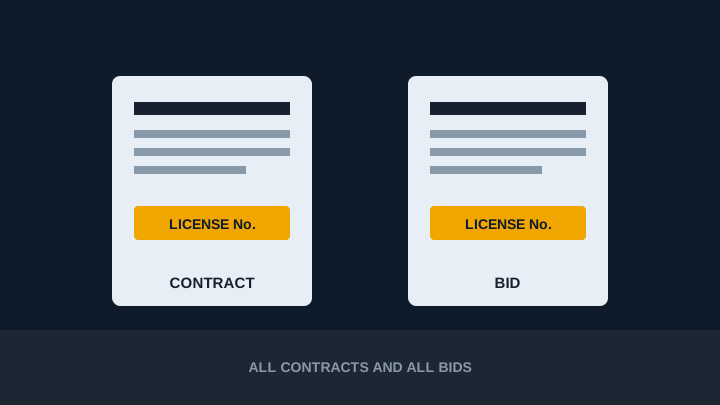
21 NCAC 12A .0501(a) is one sentence long and among the easiest rules in the chapter to breach by habit: license numbers shall be included on all contracts and bids. Not some contracts, not public work only, not above a threshold. A bid form that omits it and a subcontract template that never carried it are both out of compliance, and both are the kind of thing a complaint investigation surfaces from documents you produced yourself. This is a five-minute fix across your templates and it never has to be revisited. It is also the closing theme of this course. Almost everything in the preceding nine modules is a compliance obligation that can be discharged by a habit rather than by vigilance: a number on a template, a calendar entry for November 30, a standing item to confirm the qualifier’s hours. The licensees who lose licenses rarely do so by deciding to; they do so by leaving obligations to memory.
Authority:
The thirty-day family
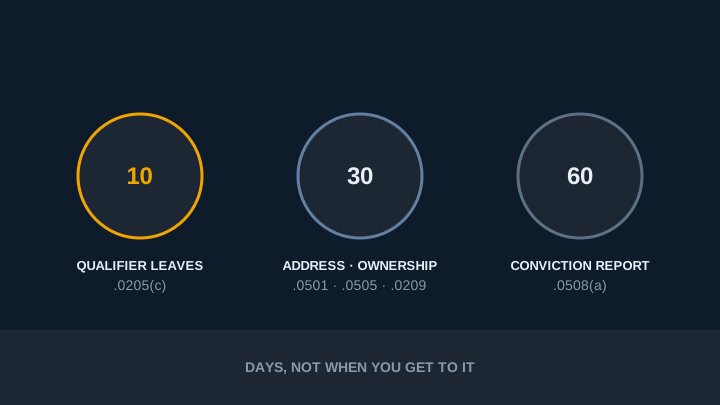
Four separate duties run on a 30-day clock, and together they cover most of what changes about a business. Under .0501(c), a licensee shall notify the Board within 30 days of a change in ownership, or of a filing with the Secretary of State that amends or changes the corporate structure of the licensed entity. Under .0501(d), within 30 days of a change of address or phone number. Under .0505(a), all licensees, applicants AND qualifiers shall notify the Board of any change in mailing address, phone number or email address within 30 days, in writing or through the Board’s portal. And under .0209(b), within 30 days of any change in the name under which the licensee is conducting business in North Carolina.
Authority: · ·
Why the address duty is not clerical
21 NCAC 12A .0505(b) supplies the reason to take the address rule seriously: notification from the Board is DEEMED RECEIVED if mailed to the address the licensee provided and shown in the Board’s records. A stale address does not pause a proceeding — it means notices of charges, hearings and deadlines are legally delivered to a place you no longer read. Combine that with .0701’s notice-by-portal-and-email machinery from Module 7, and keeping all three channels current is the difference between defending a complaint and defaulting on one.
Authority: ·
Assumed names
If a licensee operates under an assumed name, .0209(a) requires the application to be accompanied by a Certificate of Assumed Name filed under Chapter 66, Article 14A, and entity applicants to supply the documents filed with the Secretary of State. Two prohibitions follow. No applicant or licensee shall use or adopt an assumed name used by another licensee, or a name so similar to another licensee’s assumed name that it could confuse or mislead the public. The test is confusion of the public, not intent — a name adopted innocently can still fail it. The practical step is to search the Board’s licensee records for the name you intend to use before you print anything, and to keep the search result, because the cost of discovering the conflict later is rebranding rather than renaming.
Authority:
Sixty days to report a conviction
21 NCAC 12A .0508(a) is the reporting duty most likely to be missed, because it reaches further than people expect. Any licensee convicted of ANY felony OR MISDEMEANOR — not merely one connected to construction — or who is disciplined by, or enters a conciliation agreement or consent order with, any governmental agency in connection with any occupational license, shall file the Board’s Criminal Conviction Disciplinary Action Reporting Form within 60 days of the final judgment, order or disposition in the case. The clock runs from disposition, not from charge and not from when you get round to it.
Authority:
What the form asks, and who has to file
The form requires the reporting individual’s full legal name, physical and mailing address, license number, telephone number, email address, date of birth, and a description of the criminal conviction and disciplinary action including the jurisdiction and file number. It is available on the Board’s website or on request. .0508(b) identifies who must report: the same individuals who are required to submit to a criminal background check under Rule .0303 of the Subchapter. So the duty is not confined to the entity — it attaches to the individuals the Board vets. One more point about scope: the rule reaches discipline by ANY governmental agency in connection with ANY occupational license, so an action against a separate trade license — electrical, plumbing, real estate — is reportable here even though it has nothing to do with your general contracting practice.
Authority:
Two clocks that are shorter than thirty days
Set against the 30- and 60-day duties, two obligations from earlier modules run faster and are worth holding together. A licensee must notify the Board in writing within 10 days when a qualifier ceases to be connected with it, stating the last date of connection, and the qualifier must notify separately (21 NCAC 12A .0205(c)). And under .0503(c), a licensee shall provide the Board with a copy of any bankruptcy petition it files within 30 days of filing. Neither is intuitive, and both arrive at moments when paperwork is the last thing on anyone’s mind.
Authority: ·
Dissolution archives the license
.0501(b) closes a loop that catches dormant entities: if a licensee files Articles of Dissolution, or the Secretary of State withdraws the licensee’s Certificate of Authority, the Board shall archive the license. Read that with .0503(d) — a corporate license shall not be renewed unless it is in good standing with the Secretary of State — and the corporate filings and the license are effectively one compliance obligation. Letting an annual report lapse at the Secretary of State does not merely cost a late fee; downstream it can cost the license.
Authority: ·
Military training, and the criminal-history frame
Two Chapter 93B provisions sit behind the Board’s decisions. G.S. 93B-15.1 requires an occupational licensing board to issue a license to a MILITARY-TRAINED APPLICANT who has been awarded a military occupational specialty, completed the training, testing and performance in that specialty at a level substantially equivalent to or exceeding the board’s requirements, and has actively practiced the occupation for the qualifying period — with parallel provision for military spouses and for temporary licensure. G.S. 93B-8.1 governs how a board may use criminal history records in a licensure decision, and G.S. 87-10(a2) expressly routes the Board’s use of a criminal background check through it. For a veteran-owned firm, 93B-15.1 is worth reading in full before assuming the standard application path is the only one.
Authority: N.C.G.S. § 93B-15.1 · N.C.G.S. § 93B-8.1
Traducción de cortesía — la versión en inglés es la oficial del curso.
Ponga el número en el papel
La 21 NCAC 12A .0501(a) tiene una sola oración y está entre las reglas del capítulo más fáciles de infringir por costumbre: los números de licencia deberán incluirse en todos los contratos y en todas las ofertas. No en algunos contratos, no solo en obra pública, no solo por encima de un umbral. Un formulario de oferta que lo omite y una plantilla de subcontrato que nunca lo llevó están ambos en incumplimiento, y ambos son de esas cosas que una investigación de queja saca a la luz a partir de documentos que usted mismo produjo. Es un arreglo de cinco minutos en sus plantillas y nunca hay que volver a tocarlo. Es también el tema de cierre de este curso. Casi todo lo de los nueve módulos anteriores es una obligación de cumplimiento que puede descargarse con un hábito en vez de con vigilancia: un número en una plantilla, una entrada de calendario para el 30 de noviembre, un punto fijo para confirmar las horas del qualifier. Los licenciatarios que pierden su licencia rara vez lo hacen por decidirlo; lo hacen por dejar obligaciones a la memoria.
La familia de los treinta días
Cuatro deberes separados corren sobre un reloj de 30 días y, juntos, cubren casi todo lo que cambia en un negocio. Bajo la .0501(c), el licenciatario notificará a la Junta dentro de 30 días un cambio de propiedad, o una presentación ante el Secretary of State que enmiende o cambie la estructura corporativa de la entidad licenciada. Bajo la .0501(d), dentro de 30 días de un cambio de dirección o de número telefónico. Bajo la .0505(a), todos los licenciatarios, solicitantes Y qualifiers notificarán a la Junta cualquier cambio de dirección postal, teléfono o correo electrónico dentro de 30 días, por escrito o a través del portal de la Junta. Y bajo la .0209(b), dentro de 30 días de cualquier cambio del nombre bajo el cual el licenciatario conduce negocios en Carolina del Norte.
Por qué el deber de dirección no es un trámite de oficina
La 21 NCAC 12A .0505(b) aporta la razón para tomarse en serio la regla de la dirección: la notificación de la Junta se CONSIDERA RECIBIDA si se envía por correo a la dirección que el licenciatario proporcionó y que consta en los registros de la Junta. Una dirección desactualizada no pausa un procedimiento — significa que los avisos de cargos, de audiencias y de plazos quedan legalmente entregados en un lugar que usted ya no lee. Combine eso con la maquinaria de aviso por portal y correo electrónico de la .0701, vista en el Módulo 7, y mantener los tres canales al día es la diferencia entre defender una queja y perderla por rebeldía.
Nombres comerciales
Si un licenciatario opera bajo un nombre comercial (assumed name), la .0209(a) exige que la solicitud vaya acompañada de un Certificate of Assumed Name presentado bajo el Capítulo 66, Artículo 14A, y que las entidades solicitantes aporten los documentos presentados ante el Secretary of State. De ahí se siguen dos prohibiciones. Ningún solicitante ni licenciatario usará o adoptará un nombre comercial usado por otro licenciatario, ni un nombre tan similar al nombre comercial de otro licenciatario que pudiera confundir o inducir a error al público. La prueba es la confusión del público, no la intención — un nombre adoptado inocentemente puede reprobarla igual. El paso práctico es buscar el nombre que piensa usar en los registros de licenciatarios de la Junta antes de imprimir nada, y conservar el resultado de la búsqueda, porque el costo de descubrir el conflicto después es rehacer la marca y no solo cambiar el nombre.
Sesenta días para reportar una condena
La 21 NCAC 12A .0508(a) es el deber de reporte que más probablemente se pasa por alto, porque alcanza más lejos de lo que la gente espera. Todo licenciatario condenado por CUALQUIER delito grave O DELITO MENOR — no solamente uno relacionado con la construcción — o que sea sancionado por, o celebre un acuerdo de conciliación o un consent order con, cualquier agencia gubernamental en relación con cualquier licencia ocupacional, deberá presentar el Criminal Conviction Disciplinary Action Reporting Form de la Junta dentro de 60 días de la sentencia, orden o resolución final del caso. El reloj corre desde la resolución, no desde la acusación y no desde cuando usted encuentre el momento.
Qué pide el formulario, y quién debe presentarlo
El formulario requiere el nombre legal completo de quien reporta, su dirección física y postal, el número de licencia, el teléfono, el correo electrónico, la fecha de nacimiento, y una descripción de la condena penal y de la acción disciplinaria, incluidos la jurisdicción y el número de expediente. Está disponible en el sitio web de la Junta o a solicitud. La .0508(b) identifica a quién debe reportar: las mismas personas que están obligadas a someterse a una verificación de antecedentes penales bajo la Regla .0303 del Subcapítulo. De modo que el deber no se limita a la entidad — se adhiere a las personas que la Junta examina. Un punto más sobre el alcance: la regla alcanza la sanción impuesta por CUALQUIER agencia gubernamental en relación con CUALQUIER licencia ocupacional, así que una acción contra una licencia de oficio distinta — eléctrica, de plomería, de bienes raíces — es reportable aquí aunque nada tenga que ver con su ejercicio de la contratación general.
Dos relojes más cortos que treinta días
Frente a los deberes de 30 y 60 días, dos obligaciones de módulos anteriores corren más rápido y conviene sostenerlas juntas. El licenciatario debe notificar a la Junta por escrito dentro de 10 días cuando un qualifier deja de estar vinculado con él, indicando la última fecha de vinculación, y el qualifier debe notificar por separado (21 NCAC 12A .0205(c)). Y bajo la .0503(c), el licenciatario proporcionará a la Junta copia de cualquier petición de quiebra que presente, dentro de 30 días de la presentación. Ninguna de las dos es intuitiva, y ambas llegan en momentos en que el papeleo es lo último en la mente de cualquiera.
La disolución archiva la licencia
La .0501(b) cierra un circuito que atrapa a las entidades dormidas: si un licenciatario presenta Articles of Dissolution, o el Secretary of State retira el Certificate of Authority del licenciatario, la Junta archivará la licencia. Léala junto con la .0503(d) — una licencia corporativa no se renovará salvo que esté en good standing ante el Secretary of State — y las presentaciones corporativas y la licencia son en los hechos una sola obligación de cumplimiento. Dejar vencer un informe anual ante el Secretary of State no cuesta meramente un recargo; aguas abajo puede costar la licencia.
Formación militar, y el marco de antecedentes penales
Dos disposiciones del Capítulo 93B están detrás de las decisiones de la Junta. La G.S. 93B-15.1 exige que una junta de licencias ocupacionales emita una licencia al SOLICITANTE CON FORMACIÓN MILITAR al que se le haya otorgado una especialidad ocupacional militar, que haya completado la formación, los exámenes y el desempeño en esa especialidad a un nivel sustancialmente equivalente o superior a los requisitos de la junta, y que haya ejercido activamente la ocupación durante el período calificante — con disposición paralela para cónyuges de militares y para la licencia temporal. La G.S. 93B-8.1 rige cómo puede una junta usar los registros de antecedentes penales en una decisión de licencia, y la G.S. 87-10(a2) encauza expresamente por ella el uso que la Junta hace de una verificación de antecedentes. Para una firma propiedad de un veterano, vale la pena leer la 93B-15.1 completa antes de suponer que la vía de solicitud estándar es la única.
Authority & state references
- N.C.G.S. § 87-10.1 — Licensing of nonresidents ⏱ ≈ 3 min read
- — Assumed Name Application ⏱ ≈ 2 min read
- — License Granted ⏱ ≈ 2 min read
- — Maintaining Current Address; Notification ⏱ ≈ 2 min read
- — Reporting Criminal Convictions and Disciplinary Actions ⏱ ≈ 2 min read
- N.C.G.S. § 93B-8.1 — Use of Criminal History Records ⏱ ≈ 7 min read
- N.C.G.S. § 93B-15.1 — Licensure for individuals with military training and experience; proficiency examination; licensure by endorsement for military spouses; temporary license ⏱ ≈ 8 min read
Tap any citation to read it in the statute reader without leaving this page — about 26 minutes of authority reading is available in this module. Time spent here is instructional time: use it if you want more depth, or if you need additional minutes toward the 200-minute course requirement.
Official text opens on the North Carolina General Assembly site (ncleg.gov) — the source of record for every citation. Read-time figures are estimates.
Independent contractor-education provider. Not affiliated with, endorsed by, or acting for the North Carolina Licensing Board for General Contractors. Education, not legal advice — verify current statutes with the NC General Assembly.