Course outline — 200 minutes across 10 modules
- What Makes You a General Contractor · ≈ 20 min
- Classifications and Limitations · ≈ 20 min
- Financial Responsibility: Your Statements and the Bond Alternative · ≈ 20 min
- The Qualifier — Your License’s Single Point of Failure · ≈ 20 min
- Contracts, Bids and the Payment Chain · ≈ 20 min
- Permits, Inspections and the Lien-Agent Trigger · ≈ 20 min
- Liability Exposure: Discipline, Unlicensed Practice, Injunctions · ≈ 20 min
- The Homeowners Recovery Fund · ≈ 20 min
- Renewal, CE, Inactive Status and Coming Back · ≈ 20 min
- Records, Reporting and Staying in Good Standing · ≈ 20 min
MODULE 8 OF 10 · ESTIMATED 20 MIN
The Homeowners Recovery Fund
Learning objectives
- Explain what the Fund is for and how the $10 permit fee finances it.
- State what makes a loss “reimbursable” and who is excluded from claiming.
- Describe the exhaustion-of-remedies requirement and the filing deadlines.
- Explain the 10% per-claim cap and the Board’s subrogation against the contractor.
Lesson
DRAFT — pending instructor-of-record approval
A fund financed by your permits
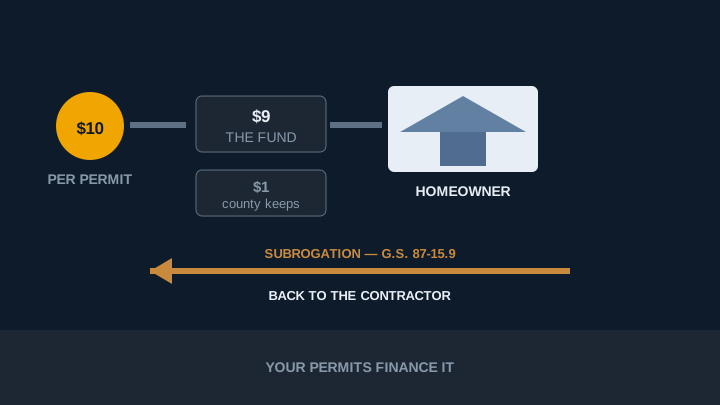
The Homeowners Recovery Fund is a special account of the Board, administered by the Board, whose purpose is to reimburse homeowners who have suffered a reimbursable loss in constructing or altering a single-family residential dwelling unit. It matters to a licensee for two reasons that pull in opposite directions. You pay into it on every residential permit. And if the Board pays a homeowner because of your conduct, the Board is subrogated and may come after you for the amount it paid. Understanding both ends is the point of this module.
Authority: N.C.G.S. § 87-15.6 · N.C.G.S. § 87-15.9
The ten-dollar fee, and where it goes
Whenever a general contractor applies for a permit to construct a single-family residential dwelling unit, or to alter an existing one, the city or county building inspector collects ten dollars ($10.00) from the general contractor for each dwelling unit under the permit. The split is fixed by statute: the inspector forwards nine dollars ($9.00) of each fee to the Board quarterly, and the city or county retains one dollar ($1.00). The Board deposits its share in the Fund and may also accept donations and appropriations. The Board may suspend collection for any year on determining the Fund is sufficient to meet likely disbursements, and must notify building inspectors when it does.
Authority: N.C.G.S. § 87-15.6
What makes a loss reimbursable — all three, not any
G.S. 87-15.5(6) defines a reimbursable loss as a monetary loss meeting all of three requirements. It results from dishonest OR incompetent conduct by a general contractor in constructing or altering a single-family residential dwelling unit. It is not paid, in whole or in part, by or on behalf of the general contractor whose conduct caused it. And it is not covered by a bond, a surety agreement, or an insurance contract. The third element is the one that disposes of most claims quietly: the Fund is a last resort behind insurance and bonds, not a parallel remedy. Note also what the definition does NOT require: there is no need to show the contractor acted dishonestly. Incompetent conduct is an independent route, and 21 NCAC 12A .0901(3) defines it as conduct demonstrating a lack of ability or fitness to discharge a duty associated with the construction or its supervision — a standard a competent contractor should never meet, but one that does not require proving intent.
Authority: N.C.G.S. § 87-15.5 ·
Who counts as a “general contractor” here
The Fund’s definition is wider than the license. Under G.S. 87-15.5(5) a general contractor means someone licensed under Article 1 — but also someone who fraudulently procures a building permit by presenting a licensed contractor’s certificate, or by falsely impersonating a licensed general contractor. That is deliberate. A homeowner defrauded by someone who was never entitled to the permit is exactly who the Fund exists for, and the definition reaches the conduct rather than the credential. “Dishonest conduct” is fraud or deceit in obtaining a license or in the practice of general contracting; “incompetent conduct” is defined by rule as conduct demonstrating a lack of ability or fitness to discharge a duty of the construction or its supervision.
Authority: N.C.G.S. § 87-15.5
Who cannot claim
21 NCAC 12A .0901(4) narrows “owner or former owner” considerably. It excludes a spouse, child, parent, grandparent, sibling, partner, associate, officer or employee of the general contractor whose conduct caused the loss. It excludes general contractors themselves, and any financial or lending institution. It excludes an owner whose dwelling has already been the subject of a Fund award arising from the same dishonest or incompetent conduct. And it excludes an owner who purchased, owned, constructed, altered or contracted for the dwelling WITHOUT intending to occupy it as a residence — which takes investors and speculative builders outside the Fund entirely.
Authority:
The permit condition, and exhaustion of remedies
G.S. 87-15.8(a) sets four eligibility requirements. The applicant must have suffered a reimbursable loss on a dwelling they own or previously owned. They must not have obtained the building permit, directly or indirectly, in their own name — or must have used a general contractor. They must have exhausted all civil remedies against the contractor and, where applicable, the contractor’s estate, and obtained a judgment that remains unsatisfied. And they must have complied with the Board’s rules. The exhaustion requirement is waived where the applicant is prevented from suing or obtaining judgment by the automatic stay under section 362 of the U.S. Bankruptcy Code.
Authority: N.C.G.S. § 87-15.8
Proving exhaustion is specific work
21 NCAC 12A .0903 tells an applicant what exhaustion actually looks like on paper: certified copies of the complaint, the judgment, and the return of execution marked unsatisfied. And the writ of execution must be shown to have been filed in three places — the county where the project was located, the county of the contractor’s last known principal place of business, and, if the contractor was a Board licensee, the county of the last address provided to the Board. Bankruptcy, death and dissolution each have their own documentary route, requiring certification that the applicant has not and will not receive payment from that source.
Authority:
The deadlines, and “whichever comes first”
21 NCAC 12A .0904 supplies two clocks and they work differently. An applicant is forever barred unless application is made within ONE YEAR after termination of all proceedings, including appeals, in connection with an unsatisfied judgment obtained against a general contractor. But a claim based upon the bankruptcy, death or dissolution of the contractor is forever barred unless application is made within THREE YEARS from the date the applicant discovered the facts constituting the dishonest or incompetent conduct, or within SIX YEARS of substantial completion of the construction or alteration — whichever comes first. That last phrase is the trap: on an older project the six-year outer limit can expire before the three-year discovery clock has run its course.
Authority:
The cap is on the Fund, not the claim — and then the Board comes for you
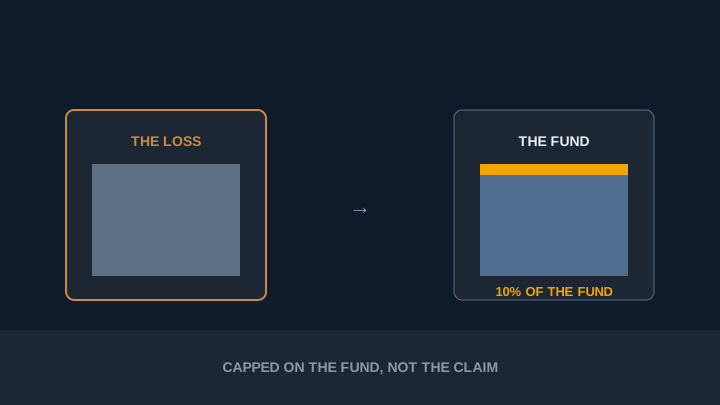
21 NCAC 12A .0910(a) provides that payment for an approved application shall not exceed an amount equal to 10 percent of the total amount IN THE FUND at the time the Board approves the application, with all applications considered at the same meeting subject to the same limitation. It is not ten percent of the homeowner’s loss. .0910(b) also excludes consequential, multiple or punitive damages, civil and criminal penalties or fines, incidental and special damages, interest and court costs from what counts as a monetary loss. Payment is discretionary — G.S. 87-15.8(b) makes it a matter of privilege and not of right. And once the Board pays, G.S. 87-15.9 subrogates it to the applicant in the amount reimbursed, with authority to sue the contractor, the contractor’s assets, or the contractor’s estate.
Authority: · N.C.G.S. § 87-15.8 · N.C.G.S. § 87-15.9
Traducción de cortesía — la versión en inglés es la oficial del curso.
Un fondo financiado por sus permisos
El Homeowners Recovery Fund es una cuenta especial de la Junta, administrada por la Junta, cuyo propósito es reembolsar a los propietarios de vivienda que han sufrido una pérdida reembolsable al construir o alterar una unidad de vivienda residencial unifamiliar. Le importa a un licenciatario por dos razones que tiran en direcciones opuestas. Usted aporta al Fondo en cada permiso residencial. Y si la Junta le paga a un propietario a causa de su conducta, la Junta queda subrogada y puede ir tras usted por el monto que pagó. Entender ambos extremos es el punto de este módulo.
La cuota de diez dólares, y a dónde va
Cada vez que un contratista general solicita un permiso para construir una unidad de vivienda residencial unifamiliar, o para alterar una existente, el inspector de construcción de la ciudad o del condado cobra diez dólares ($10.00) al contratista general por cada unidad de vivienda amparada por el permiso. El reparto lo fija la ley: el inspector remite nueve dólares ($9.00) de cada cuota a la Junta trimestralmente, y la ciudad o el condado retiene un dólar ($1.00). La Junta deposita su parte en el Fondo y también puede aceptar donaciones y asignaciones presupuestales. La Junta puede suspender el cobro en cualquier año si determina que el Fondo es suficiente para atender los desembolsos probables, y debe notificarlo a los inspectores de construcción cuando lo haga.
Qué hace reembolsable una pérdida — los tres, no cualquiera
La G.S. 87-15.5(6) define la pérdida reembolsable como una pérdida monetaria que cumple los tres requisitos. Resulta de conducta deshonesta O incompetente de un contratista general al construir o alterar una unidad de vivienda residencial unifamiliar. No es pagada, ni total ni parcialmente, por el contratista general cuya conducta la causó o en su nombre. Y no está cubierta por una fianza, un acuerdo de garantía o un contrato de seguro. El tercer elemento es el que despacha calladamente la mayoría de las reclamaciones: el Fondo es un último recurso detrás del seguro y de las fianzas, no un remedio paralelo. Note además lo que la definición NO exige: no hace falta demostrar que el contratista actuó deshonestamente. La conducta incompetente es una vía independiente, y la 21 NCAC 12A .0901(3) la define como conducta que demuestra falta de capacidad o de aptitud para cumplir un deber asociado a la construcción o a su supervisión — un estándar que un contratista competente nunca debería alcanzar, pero que no exige probar intención.
Quién cuenta como “general contractor” aquí
La definición del Fondo es más amplia que la licencia. Bajo la G.S. 87-15.5(5), general contractor significa alguien licenciado bajo el Artículo 1 — pero también alguien que obtiene fraudulentamente un permiso de construcción presentando el certificado de un contratista licenciado, o haciéndose pasar falsamente por un contratista general licenciado. Eso es deliberado. Un propietario defraudado por alguien que nunca tuvo derecho al permiso es exactamente para quien existe el Fondo, y la definición alcanza la conducta y no la credencial. La “conducta deshonesta” es fraude o engaño en la obtención de una licencia o en el ejercicio de la contratación general; la “conducta incompetente” está definida por regla como conducta que demuestra falta de capacidad o de aptitud para cumplir un deber de la construcción o de su supervisión.
Quién no puede reclamar
La 21 NCAC 12A .0901(4) estrecha considerablemente la figura de “propietario o antiguo propietario”. Excluye al cónyuge, hijo, padre o madre, abuelo o abuela, hermano o hermana, socio, asociado, funcionario o empleado del contratista general cuya conducta causó la pérdida. Excluye a los propios contratistas generales, y a toda institución financiera o de crédito. Excluye al propietario cuya vivienda ya fue objeto de un pago del Fondo derivado de la misma conducta deshonesta o incompetente. Y excluye al propietario que compró, poseyó, construyó, alteró o contrató la vivienda SIN la intención de ocuparla como residencia — lo cual deja a inversionistas y constructores especulativos enteramente fuera del Fondo.
La condición del permiso, y el agotamiento de remedios
La G.S. 87-15.8(a) fija cuatro requisitos de elegibilidad. El solicitante debe haber sufrido una pérdida reembolsable en una vivienda que posee o poseyó antes. No debe haber obtenido el permiso de construcción, directa o indirectamente, a su propio nombre — o debe haber usado un contratista general. Debe haber agotado todos los remedios civiles contra el contratista y, cuando corresponda, contra la sucesión del contratista, y haber obtenido una sentencia que permanece insatisfecha. Y debe haber cumplido con las reglas de la Junta. El requisito de agotamiento se dispensa cuando el solicitante está impedido de demandar o de obtener sentencia por la suspensión automática de la sección 362 del U.S. Bankruptcy Code.
Probar el agotamiento es trabajo específico
La 21 NCAC 12A .0903 le dice al solicitante cómo se ve el agotamiento efectivamente en papel: copias certificadas de la demanda, de la sentencia y de la devolución de ejecución marcada como insatisfecha. Y debe demostrarse que la orden de ejecución fue presentada en tres lugares — el condado donde se ubicó el proyecto, el condado del último domicilio principal de negocios conocido del contratista y, si el contratista era licenciatario de la Junta, el condado de la última dirección proporcionada a la Junta. La quiebra, la muerte y la disolución tienen cada una su propia vía documental, y exigen certificar que el solicitante no ha recibido ni recibirá pago de esa fuente.
Los plazos, y “lo que ocurra primero”
La 21 NCAC 12A .0904 aporta dos relojes y funcionan de manera distinta. El solicitante queda impedido para siempre salvo que presente la solicitud dentro de UN AÑO después de terminados todos los procedimientos, incluidas las apelaciones, relacionados con una sentencia insatisfecha obtenida contra un contratista general. Pero una reclamación basada en la quiebra, la muerte o la disolución del contratista queda impedida para siempre salvo que la solicitud se presente dentro de TRES AÑOS desde la fecha en que el solicitante descubrió los hechos constitutivos de la conducta deshonesta o incompetente, o dentro de SEIS AÑOS de la terminación sustancial de la construcción o alteración — lo que ocurra primero. Esa última frase es la trampa: en un proyecto antiguo, el límite exterior de seis años puede vencer antes de que el reloj de descubrimiento de tres años haya corrido su curso.
El tope es sobre el Fondo, no sobre la reclamación — y luego la Junta va por usted
La 21 NCAC 12A .0910(a) dispone que el pago por una solicitud aprobada no excederá un monto igual al 10 por ciento del total que haya EN EL FONDO al momento en que la Junta aprueba la solicitud, y todas las solicitudes consideradas en la misma reunión quedan sujetas a la misma limitación. No es el diez por ciento de la pérdida del propietario. La .0910(b) también excluye de lo que cuenta como pérdida monetaria los daños consecuenciales, múltiples o punitivos, las penas y multas civiles y penales, los daños incidentales y especiales, los intereses y las costas judiciales. El pago es discrecional — la G.S. 87-15.8(b) lo hace materia de privilegio y no de derecho. Y una vez que la Junta paga, la G.S. 87-15.9 la subroga en el lugar del solicitante por el monto reembolsado, con facultad de demandar al contratista, a sus bienes o a su sucesión.
Authority & state references
- N.C.G.S. § 87-15.5 — Definitions ⏱ ≈ 3 min read
- N.C.G.S. § 87-15.6 — Homeowners Recovery Fund ⏱ ≈ 2 min read
- N.C.G.S. § 87-15.7 — Fund administration ⏱ ≈ 2 min read
- N.C.G.S. § 87-15.8 — Application for reimbursement ⏱ ≈ 3 min read
- N.C.G.S. § 87-15.9 — Subrogation for reimbursement made ⏱ ≈ 2 min read
- — Definitions ⏱ ≈ 3 min read
- — Application for Payment ⏱ ≈ 3 min read
- — Limitations; Pro Rata Distribution ⏱ ≈ 2 min read
- — Filing Deadline and Service ⏱ ≈ 2 min read
Tap any citation to read it in the statute reader without leaving this page — about 22 minutes of authority reading is available in this module. Time spent here is instructional time: use it if you want more depth, or if you need additional minutes toward the 200-minute course requirement.
Official text opens on the North Carolina General Assembly site (ncleg.gov) — the source of record for every citation. Read-time figures are estimates.
Independent contractor-education provider. Not affiliated with, endorsed by, or acting for the North Carolina Licensing Board for General Contractors. Education, not legal advice — verify current statutes with the NC General Assembly.