Course outline — 200 minutes across 10 modules
- What Makes You a General Contractor · ≈ 20 min
- Classifications and Limitations · ≈ 20 min
- Financial Responsibility: Your Statements and the Bond Alternative · ≈ 20 min
- The Qualifier — Your License’s Single Point of Failure · ≈ 20 min
- Contracts, Bids and the Payment Chain · ≈ 20 min
- Permits, Inspections and the Lien-Agent Trigger · ≈ 20 min
- Liability Exposure: Discipline, Unlicensed Practice, Injunctions · ≈ 20 min
- The Homeowners Recovery Fund · ≈ 20 min
- Renewal, CE, Inactive Status and Coming Back · ≈ 20 min
- Records, Reporting and Staying in Good Standing · ≈ 20 min
MODULE 4 OF 10 · ESTIMATED 20 MIN
The Qualifier — Your License’s Single Point of Failure
Learning objectives
- Apply the “responsible managing” test — 20 hours per week or a majority of hours worked.
- Explain the W-2 requirement for a qualifier who is not an owner, officer or partner.
- State the 90-day replacement window and what the licensee may not do during it.
- Describe how examination credentials archive after four consecutive inactive years.
Lesson
DRAFT — pending instructor-of-record approval
One person holds the license up
A North Carolina general contractor license is issued to a company, but it stands on an individual. The qualifier is the person who sat and passed the examination in the license’s classification, and the license exists only while that person remains properly connected to the licensee. That is an unusual amount of weight to rest on one employment relationship, and it is why the qualifier is worth treating as a business-continuity risk rather than an HR detail. Everything in this module follows from that single structural fact: lose the qualifier and you have 90 days, during which you may not take new work.
Authority: N.C.G.S. § 87-10(c1)
Who is allowed to be one
Under 21 NCAC 12A .0205(a) the qualifier must be a responsible managing employee, officer, or member of the personnel of the applicant. There is a hard cap on concentration: a person may serve as qualifier for no more than two licenses. That cap exists to stop one credential being spread across a stable of companies, and a licensee recruiting an experienced qualifier should confirm how many licenses that person already carries before building a plan around them. .0205(g) allows a licensee to have more than one qualifier — and where a license is to cover a classification, it will be issued only in a classification held by a qualifier who passed the examination in it.
Authority:
“Responsible managing,” defined precisely
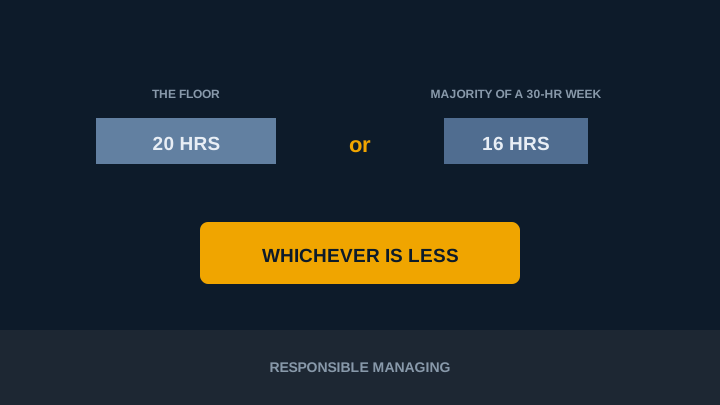
.0205(e) supplies the test, and the last three words carry it: a responsible managing person is engaged in the work of the applicant a minimum of 20 hours per week, or a majority of the hours operated by the applicant, whichever is less. For a company running a normal week, 20 hours is the floor. For a company that operates only 30 hours a week, the majority figure — 16 hours — is lower and therefore controls. Read the clause the other way round and you get the common error: treating 20 hours as an absolute minimum in every case, and concluding a qualifier at a part-time operation is non-compliant when the rule says otherwise.
Authority:
The W-2 rule, and why it has teeth
Two provisions turn the qualifier relationship into a documented employment one. Under .0205(e), if the responsible managing person is not an owner, officer, or partner of the applicant, that person must be a W-2 employee. Under .0205(f), a “member of the personnel” must be a W-2 employee and shall not be an independent contractor. The effect is that a licensee cannot rent a qualifier on a 1099. This is the provision behind most license-lending arrangements that come apart, and it connects back to the misconduct definition: allowing a credential to be used on an undertaking it does not properly cover is disciplinable in its own right.
Authority:
Who may sit the examination
G.S. 87-10(c) sets out who can take the examination on an applicant’s behalf. Where the applicant is an individual, the examination may be taken by that person appearing personally, or by the appearance of one or more of the individual’s responsible managing employees. Where the applicant is a copartnership, a corporation, or any other combination or organization, it may be taken by one or more of the responsible managing officers or members of the personnel. 21 NCAC 12A .0205(d) adds that a partner may sit on behalf of a partnership. The through-line is that the person sitting the examination must already be inside the business in a managing capacity — the credential is not meant to be acquired first and attached to a company afterwards.
Authority: N.C.G.S. § 87-10(c) ·
Ten days to tell the Board
.0205(c) imposes a notification duty the moment a qualifier ceases to be connected with the licensee. The licensee shall notify the Board in writing, stating the date the qualifier was last connected, no later than 10 days after the date of separation. The qualifier is separately required to notify the Board in writing as well. Once that notice is filed — or once the Board determines the qualifier is no longer connected — and if there are no additional qualifiers, the license is invalidated in accordance with G.S. 87-10. Ten days is a short clock for something that usually happens in the middle of a difficult week.
Authority:
The 90-day window, and what it does not permit
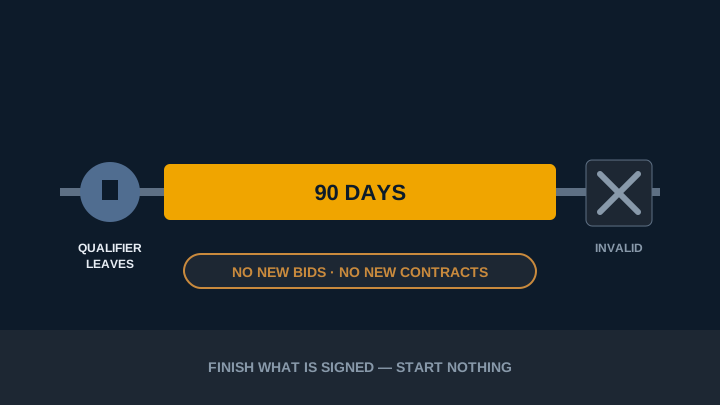
G.S. 87-10(c1) is the provision most often half-remembered. If the qualifier ceases to be connected with the licensee, the license remains in full force and effect for a period of 90 days; after 90 days it is invalidated, though the licensee is entitled to return to active status under the relevant statutes and Board rules. Here is the half that gets forgotten: during that 90-day period the licensee shall not bid on or undertake any additional contracts, from the moment the qualifier ceased to be connected until the license is reinstated. The window is not a grace period for business as usual. It exists so a contractor can finish work already under contract while finding a replacement — and bidding during it is a violation even though the license is technically still in force.
Authority: N.C.G.S. § 87-10(c1)
Four years, and the credential archives
.0205(a) sets a use-it-or-lose-it rule on the examination itself. A qualifier’s examination credentials archive if the qualifier does not serve as a qualifier for an active licensee for a period of four consecutive years. Once archived, that person must retake the examination and earn a passing grade to serve again. For a qualifier who steps back from the industry, or whose company goes dormant, the four-year clock is running quietly in the background. For a licensee, it means a former qualifier you might hope to bring back is not necessarily still qualified. The archive rule bites hardest in exactly the situation where a licensee is least able to absorb it: a company that has been dormant for several years, reactivating, and reaching for the person who qualified it last time. Check the credential before you build the plan around the person, because retaking and passing the examination is not a same-week fix.
Authority:
One more gate on the way in
.0205(b) gives the Board discretion at the front door. Subject to G.S. 150B and the Board’s own hearing rules, the Board may reject the application of an applicant seeking qualification by employing a person who has already passed an examination, where that person previously served as qualifier for a licensee the Board has disciplined. The practical consequence for a licensee is that a qualifier’s history travels with them. Diligence on a prospective qualifier is not only about hours and W-2 status; it is about whether that credential carries a disciplinary shadow that could cost you the application entirely.
Authority:
Traducción de cortesía — la versión en inglés es la oficial del curso.
Una sola persona sostiene la licencia
Una licencia de contratista general de Carolina del Norte se emite a una empresa, pero se sostiene sobre una persona. El qualifier es quien presentó y aprobó el examen en la clasificación de la licencia, y la licencia existe solo mientras esa persona permanezca debidamente vinculada al licenciatario. Es una cantidad inusual de peso para descansar sobre una sola relación laboral, y por eso conviene tratar al qualifier como un riesgo de continuidad del negocio y no como un detalle de recursos humanos. Todo lo de este módulo se desprende de ese único hecho estructural: si pierde al qualifier, tiene 90 días, y durante ellos no puede tomar trabajo nuevo.
Quién puede serlo
Bajo 21 NCAC 12A .0205(a) el qualifier debe ser un empleado directivo responsable (responsible managing employee), un funcionario o un miembro del personal del solicitante. Hay un tope duro a la concentración: una persona puede servir como qualifier para no más de dos licencias. Ese tope existe para impedir que una sola credencial se reparta entre un conjunto de empresas, y el licenciatario que recluta a un qualifier con experiencia debería confirmar cuántas licencias ya carga esa persona antes de construir un plan alrededor de ella. La .0205(g) permite que un licenciatario tenga más de un qualifier — y cuando una licencia ha de cubrir una clasificación, se emitirá únicamente en una clasificación que posea un qualifier que aprobó el examen en ella.
“Responsible managing”, definido con precisión
La .0205(e) aporta la prueba, y las últimas tres palabras la definen: una persona directiva responsable está dedicada al trabajo del solicitante un mínimo de 20 horas por semana, o la mayoría de las horas que opera el solicitante, lo que sea menor. Para una empresa con una semana normal, 20 horas es el piso. Para una empresa que opera solo 30 horas por semana, la cifra de la mayoría — 16 horas — es menor y por lo tanto es la que rige. Lea la cláusula al revés y obtiene el error común: tratar las 20 horas como un mínimo absoluto en todos los casos, y concluir que un qualifier en una operación de tiempo parcial está en incumplimiento cuando la regla dice lo contrario.
La regla del W-2, y por qué tiene dientes
Dos disposiciones convierten la relación con el qualifier en una relación laboral documentada. Bajo la .0205(e), si la persona directiva responsable no es propietaria, funcionaria o socia del solicitante, esa persona debe ser empleada con formulario W-2. Bajo la .0205(f), un “miembro del personal” debe ser empleado W-2 y no podrá ser contratista independiente. El efecto es que un licenciatario no puede alquilar un qualifier con un 1099. Esta es la disposición detrás de la mayoría de los arreglos de préstamo de licencia que terminan mal, y conecta de vuelta con la definición de conducta indebida: permitir que una credencial se use en una obra que no cubre debidamente es sancionable por sí solo.
Quién puede presentar el examen
G.S. 87-10(c) establece quién puede presentar el examen en nombre de un solicitante. Cuando el solicitante es una persona natural, el examen puede presentarlo esa persona compareciendo personalmente, o mediante la comparecencia de uno o más de sus empleados directivos responsables. Cuando el solicitante es una copartnership, una corporación o cualquier otra combinación u organización, puede presentarlo uno o más de los funcionarios directivos responsables o miembros del personal. La 21 NCAC 12A .0205(d) agrega que un socio puede presentarlo en nombre de una sociedad. El hilo conductor es que quien presenta el examen ya debe estar dentro del negocio en calidad directiva — la credencial no está pensada para adquirirse primero y adherirse a una empresa después.
Diez días para avisar a la Junta
La .0205(c) impone un deber de notificación desde el momento en que un qualifier deja de estar vinculado al licenciatario. El licenciatario notificará a la Junta por escrito, indicando la fecha en que el qualifier estuvo vinculado por última vez, a más tardar 10 días después de la fecha de separación. Al qualifier se le exige por separado notificar también a la Junta por escrito. Una vez presentado ese aviso — o una vez que la Junta determina que el qualifier ya no está vinculado — y si no hay qualifiers adicionales, la licencia queda invalidada conforme a G.S. 87-10. Diez días es un reloj corto para algo que suele ocurrir en medio de una semana difícil.
La ventana de 90 días, y lo que no permite
G.S. 87-10(c1) es la disposición que más a menudo se recuerda a medias. Si el qualifier deja de estar vinculado al licenciatario, la licencia permanece en plena vigencia y efecto por un período de 90 días; pasados los 90 días queda invalidada, aunque el licenciatario tiene derecho a volver al estado activo conforme a las leyes y reglas de la Junta aplicables. Esta es la mitad que se olvida: durante ese período de 90 días el licenciatario no podrá licitar ni emprender contratos adicionales, desde el momento en que el qualifier dejó de estar vinculado hasta que la licencia se restablezca. La ventana no es un período de gracia para seguir como si nada. Existe para que un contratista pueda terminar el trabajo ya contratado mientras busca un reemplazo — y licitar durante ella es una infracción aunque la licencia siga técnicamente vigente.
Cuatro años, y la credencial se archiva
La .0205(a) fija una regla de úselo-o-piérdalo sobre el examen mismo. Las credenciales de examen de un qualifier se archivan si esa persona no sirve como qualifier de un licenciatario activo durante un período de cuatro años consecutivos. Una vez archivadas, esa persona debe volver a presentar el examen y obtener una calificación aprobatoria para servir de nuevo. Para un qualifier que se retira del sector, o cuya empresa queda inactiva, el reloj de cuatro años corre calladamente de fondo. Para un licenciatario, significa que un antiguo qualifier al que quizá espera traer de vuelta no necesariamente sigue calificado. La regla del archivo muerde más fuerte justo en la situación en que el licenciatario menos puede absorberla: una empresa que lleva varios años inactiva, reactivándose, y buscando a la persona que la calificó la vez pasada. Verifique la credencial antes de construir el plan alrededor de la persona, porque volver a presentar y aprobar el examen no es un arreglo de la misma semana.
Una compuerta más a la entrada
La .0205(b) otorga discreción a la Junta en la puerta de entrada. Sujeta a G.S. 150B y a las propias reglas de audiencia de la Junta, la Junta puede rechazar la solicitud de un solicitante que busca calificarse empleando a una persona que ya aprobó un examen, cuando esa persona sirvió previamente como qualifier de un licenciatario que la Junta ha sancionado. La consecuencia práctica para un licenciatario es que el historial de un qualifier viaja con él. La diligencia sobre un qualifier prospectivo no trata solo de horas y estatus W-2; trata de si esa credencial carga una sombra disciplinaria que podría costarle la solicitud entera.
Authority & state references
- N.C.G.S. § 87-10(b) — Application for license; examination; certificate; renewal — subsection (b) ⏱ ≈ 3 min read
- N.C.G.S. § 87-10(c) — Application for license; examination; certificate; renewal — subsection (c) ⏱ ≈ 2 min read
- N.C.G.S. § 87-10(c1) — Application for license; examination; certificate; renewal — subsection (c1) ⏱ ≈ 2 min read
- — Qualifier ⏱ ≈ 3 min read
- — Definitions ⏱ ≈ 3 min read
Tap any citation to read it in the statute reader without leaving this page — about 13 minutes of authority reading is available in this module. Time spent here is instructional time: use it if you want more depth, or if you need additional minutes toward the 200-minute course requirement.
Official text opens on the North Carolina General Assembly site (ncleg.gov) — the source of record for every citation. Read-time figures are estimates.
Independent contractor-education provider. Not affiliated with, endorsed by, or acting for the North Carolina Licensing Board for General Contractors. Education, not legal advice — verify current statutes with the NC General Assembly.