Course outline — 200 minutes across 10 modules
- What Makes You a General Contractor · ≈ 20 min
- Classifications and Limitations · ≈ 20 min
- Financial Responsibility: Your Statements and the Bond Alternative · ≈ 20 min
- The Qualifier — Your License’s Single Point of Failure · ≈ 20 min
- Contracts, Bids and the Payment Chain · ≈ 20 min
- Permits, Inspections and the Lien-Agent Trigger · ≈ 20 min
- Liability Exposure: Discipline, Unlicensed Practice, Injunctions · ≈ 20 min
- The Homeowners Recovery Fund · ≈ 20 min
- Renewal, CE, Inactive Status and Coming Back · ≈ 20 min
- Records, Reporting and Staying in Good Standing · ≈ 20 min
MODULE 3 OF 10 · ESTIMATED 20 MIN
Financial Responsibility: Your Statements and the Bond Alternative
Learning objectives
- State the working-capital or net-worth requirement for each license limitation.
- Explain when an agreed-upon procedures report or audited financial statement is required.
- Evaluate the surety-bond alternative and its amounts as a substitute for demonstrated working capital.
- Recognize the twelve-month currency rule and the bankruptcy-disclosure requirement.
Lesson
DRAFT — pending instructor-of-record approval
Why the Board asks about money at all
A license limitation is a promise the State makes to owners: a contractor carrying this certificate can absorb a project of this size. The financial requirements in 21 NCAC 12A .0204 are how that promise is underwritten. They are not a credit check and they are not about profitability — the Board is testing whether the applicant has liquid room to keep paying subcontractors and suppliers when a project goes sideways. That is why the measure is working capital, current assets minus current liabilities, rather than revenue or equipment value. A contractor with $4,000,000 in yellow iron and no cash fails this test, and the rule is designed to fail exactly that contractor.
Authority:
The three thresholds
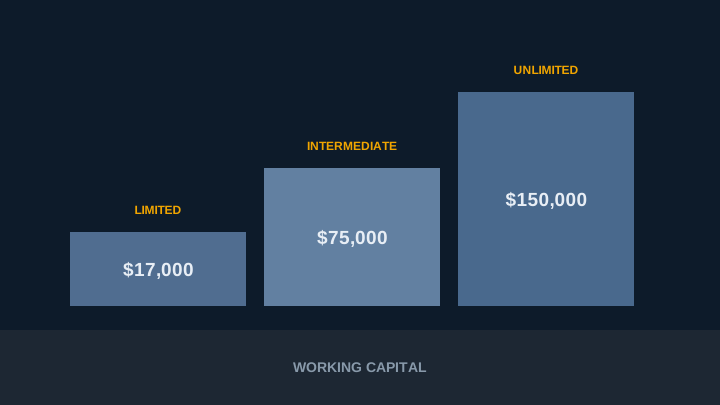
Each limitation carries its own figure. A limited license applicant must have current assets exceeding total current liabilities by at least seventeen thousand dollars ($17,000) — or, in the alternative, a total net worth of at least eighty thousand dollars ($80,000). An intermediate applicant must show working capital of at least seventy-five thousand dollars ($75,000). An unlimited applicant must show at least one hundred fifty thousand dollars ($150,000). Set those beside the project ceilings from the previous module and the ratios are informative rather than arbitrary: $150,000 of working capital underwrites unlimited project value, while $17,000 underwrites $750,000. One point of vocabulary is worth fixing here, because the rule leans on it throughout. Working capital is a snapshot of liquidity over the next operating cycle — current assets less current liabilities — so retainage you cannot collect this year, and a line of credit already drawn, both move the number against you. Net worth is the whole balance sheet, assets less liabilities, and it can be large while working capital is negative. The Board asks a different question at different tiers precisely because those two figures answer different questions.
Authority: · ·
The limited license has two doors; the others have one
Only the limited tier offers the working-capital-or-net-worth choice. .0204(b)(2) is written in the disjunctive — $17,000 in working capital OR $80,000 in total net worth — which matters to a sole proprietor whose balance sheet is asset-heavy and cash-light. The intermediate and unlimited paragraphs, .0204(c)(2) and (d)(2), offer no such alternative. They require working capital and nothing else will do. A contractor moving up from limited to intermediate on the strength of net worth will find the door closed: net worth is not a substitute above the limited tier.
Authority: ·
Who has to prove it, and to what standard
The evidentiary burden also differs by tier, and this is the part most often misread. For intermediate and unlimited, .0204(c)(2) and (d)(2) require the working capital to be reflected in an agreed-upon procedures report on a Board-provided form, or an audited financial statement prepared by a certified public accountant or an independent accountant engaged in the public practice of accountancy. The limited paragraph imposes no equivalent requirement on its face. A limited applicant is not ordinarily buying an audit — unless the bankruptcy provision in the next section pulls them in.
Authority:
The bankruptcy trigger, and where it actually sits
.0204(b)(4) requires an agreed-upon procedures report or an audited financial statement with a classified balance sheet where the applicant, or any owner, principal, or qualifier, is in bankruptcy or has been in bankruptcy within five years before the application is filed. Read where it sits: this provision is in paragraph (b), the LIMITED license paragraph. Its practical effect is to raise a limited applicant to the same evidentiary standard intermediate and unlimited applicants already carry. Note also how wide the trigger is — it reaches an owner, a principal, or a qualifier, not just the applicant entity, so a qualifier’s personal bankruptcy three years ago pulls the whole application into the reporting requirement. Shareholders of a publicly traded applicant are expressly carved out.
Authority:
The surety bond alternative
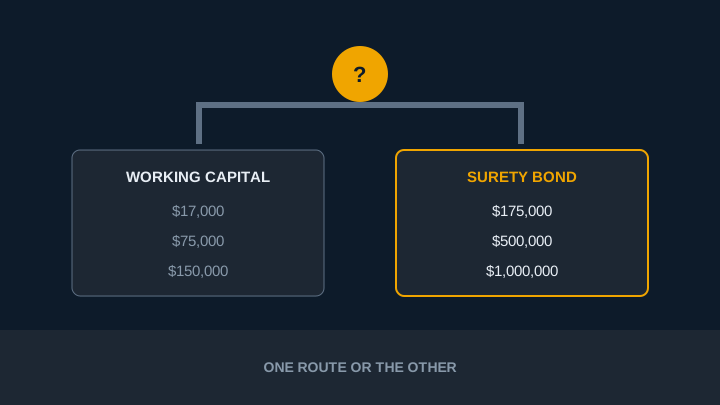
An applicant who cannot show the working capital, or the net worth at the limited tier, may post a surety bond instead. .0204(e) sets the amounts: one hundred seventy-five thousand dollars ($175,000) for a limited license, five hundred thousand dollars ($500,000) for intermediate, and one million dollars ($1,000,000) for unlimited. The bond is roughly ten times the working capital it replaces at the limited tier and closer to six or seven times at the others — the Board is not treating the two routes as equivalent, and a contractor choosing the bond is paying a premium for the privilege of not tying up cash.
Authority:
What the bond has to be
The requirements are specific. The surety must be authorized to transact surety business in North Carolina under G.S. 58, Articles 7, 16, 21 or 22, and must hold an A.M. Best rating of Superior (A++ or A+) or Excellent (A or A-). The bond must be continuous in form and maintained for as long as the license is held, or until the applicant demonstrates the required working capital. Proof goes in with the application form and with every annual renewal. The State of North Carolina is the obligee, and the bond runs for the benefit of anyone damaged by the contractor’s breach of a construction contract, breach of a contract for labor, materials or professional services, or unlawful act or omission in performing a construction contract. It is in addition to — never in lieu of — any other bond required by law or by a contract.
Authority:
Cancellation is a 30-day fuse
If the surety cancels, both the surety and the applicant must notify the Board in writing within 30 days. The applicant then has 30 days from cancellation to provide written proof of financial responsibility in compliance with the rule. Fail that, and the license is suspended until proof is provided. Two things follow for a licensee relying on a bond. The notification duty is yours as well as your surety’s — assuming the surety will handle it does not discharge your obligation. And the cure window runs from cancellation, not from the day you noticed, so the practical deadline is shorter than 30 days by however long the letter sat unopened.
Authority:
Twelve months, and GAAP
Two standards govern the paperwork itself. Under .0204(f), financial statements submitted to the Board shall be no older than twelve months from the date of submission — a statement prepared for last year’s renewal will not carry this year’s application. And statements must conform to United States generally accepted accounting principles. The rule permits narrow non-GAAP presentation where it is necessary to ascertain working capital or net worth: classifying assets and liabilities as current and noncurrent on a personal financial statement, or not combining the applicant with a related entity under ASC 810. Those are exceptions defined by purpose, not a general license to depart from GAAP.
Authority:
Traducción de cortesía — la versión en inglés es la oficial del curso.
Por qué la Junta pregunta por dinero
Una limitación de licencia es una promesa que el Estado hace a los propietarios: un contratista que porta este certificado puede absorber un proyecto de este tamaño. Los requisitos financieros de 21 NCAC 12A .0204 son la forma en que esa promesa queda respaldada. No son una verificación de crédito y no tratan de la rentabilidad — la Junta está probando si el solicitante tiene margen líquido para seguir pagando a subcontratistas y proveedores cuando un proyecto se tuerce. Por eso la medida es el capital de trabajo, activo circulante menos pasivo circulante, y no los ingresos ni el valor del equipo. Un contratista con $4,000,000 en maquinaria pesada y sin efectivo reprueba esta prueba, y la regla está diseñada para reprobar exactamente a ese contratista.
Los tres umbrales
Cada limitación lleva su propia cifra. Un solicitante de licencia Limited debe tener activo circulante que exceda el pasivo circulante total en al menos diecisiete mil dólares ($17,000) — o, en la alternativa, un patrimonio neto total de al menos ochenta mil dólares ($80,000). Un solicitante Intermediate debe demostrar capital de trabajo de al menos setenta y cinco mil dólares ($75,000). Un solicitante Unlimited debe demostrar al menos ciento cincuenta mil dólares ($150,000). Póngalas junto a los topes de proyecto del módulo anterior y las proporciones resultan informativas más que arbitrarias: $150,000 de capital de trabajo respaldan un valor de proyecto ilimitado, mientras que $17,000 respaldan $750,000. Vale la pena fijar aquí un punto de vocabulario, porque la regla se apoya en él de principio a fin. El capital de trabajo es una fotografía de la liquidez durante el siguiente ciclo operativo — activo circulante menos pasivo circulante — de modo que la retención que no podrá cobrar este año, y una línea de crédito ya dispuesta, mueven ambas la cifra en su contra. El patrimonio neto es el balance completo, activo menos pasivo, y puede ser grande mientras el capital de trabajo es negativo. La Junta hace una pregunta distinta en cada nivel precisamente porque esas dos cifras responden preguntas distintas.
La licencia Limited tiene dos puertas; las demás, una
Solo el nivel Limited ofrece la opción entre capital de trabajo y patrimonio neto. La .0204(b)(2) está redactada en forma disyuntiva — $17,000 de capital de trabajo O $80,000 de patrimonio neto total — lo cual importa para un propietario único cuyo balance es pesado en activos y escaso en efectivo. Los párrafos Intermediate y Unlimited, .0204(c)(2) y (d)(2), no ofrecen tal alternativa. Exigen capital de trabajo y ninguna otra cosa sirve. Un contratista que sube de Limited a Intermediate apoyándose en su patrimonio neto encontrará la puerta cerrada: el patrimonio neto no sustituye al capital de trabajo por encima del nivel Limited.
Quién debe probarlo, y con qué estándar
La carga probatoria también difiere por nivel, y esta es la parte que más a menudo se lee mal. Para Intermediate y Unlimited, la .0204(c)(2) y la (d)(2) exigen que el capital de trabajo conste en un informe de procedimientos convenidos en un formulario provisto por la Junta, o en un estado financiero auditado preparado por un contador público certificado o por un contador independiente dedicado al ejercicio público de la contaduría. El párrafo de Limited no impone en su texto un requisito equivalente. Un solicitante Limited no está comprando ordinariamente una auditoría — salvo que la disposición sobre quiebra de la próxima sección lo arrastre a ella.
El disparador de quiebra, y dónde está realmente ubicado
La .0204(b)(4) exige un informe de procedimientos convenidos o un estado financiero auditado con un balance clasificado cuando el solicitante, o cualquier propietario, principal o qualifier, está en quiebra o ha estado en quiebra dentro de los cinco años anteriores a la presentación de la solicitud. Fíjese dónde está ubicada: esta disposición está en el párrafo (b), el párrafo de la licencia LIMITED. Su efecto práctico es elevar al solicitante Limited al mismo estándar probatorio que los solicitantes Intermediate y Unlimited ya cargan. Note también qué amplio es el disparador — alcanza a un propietario, un principal o un qualifier, no solo a la entidad solicitante, de modo que la quiebra personal de un qualifier hace tres años arrastra toda la solicitud al requisito de reporte. Los accionistas de un solicitante que cotiza en bolsa quedan expresamente excluidos.
La alternativa de la fianza de garantía
Un solicitante que no pueda demostrar el capital de trabajo, o el patrimonio neto en el nivel Limited, puede en su lugar constituir una fianza de garantía (surety bond). La .0204(e) fija los montos: ciento setenta y cinco mil dólares ($175,000) para una licencia Limited, quinientos mil dólares ($500,000) para Intermediate y un millón de dólares ($1,000,000) para Unlimited. La fianza equivale a unas diez veces el capital de trabajo que reemplaza en el nivel Limited, y a unas seis o siete veces en los demás — la Junta no trata ambas rutas como equivalentes, y el contratista que elige la fianza paga una prima por el privilegio de no inmovilizar efectivo.
Cómo debe ser la fianza
Los requisitos son específicos. La aseguradora (surety) debe estar autorizada para realizar operaciones de fianza en Carolina del Norte conforme a G.S. 58, Artículos 7, 16, 21 o 22, y debe tener una calificación A.M. Best de Superior (A++ o A+) o Excellent (A o A-). La fianza debe ser continua en su forma y mantenerse mientras se conserve la licencia, o hasta que el solicitante demuestre el capital de trabajo exigido. La prueba se presenta con el formulario de solicitud y con cada renovación anual. El Estado de Carolina del Norte es el beneficiario (obligee), y la fianza corre en beneficio de cualquier persona dañada por el incumplimiento del contratista de un contrato de construcción, el incumplimiento de un contrato de mano de obra, materiales o servicios profesionales, o un acto u omisión ilícitos en la ejecución de un contrato de construcción. Es adicional a — nunca en lugar de — cualquier otra fianza exigida por ley o por contrato.
La cancelación es una mecha de 30 días
Si la aseguradora cancela, tanto la aseguradora como el solicitante deben notificar por escrito a la Junta dentro de 30 días. El solicitante tiene entonces 30 días desde la cancelación para aportar prueba escrita de responsabilidad financiera conforme a la regla. Si no lo hace, la licencia queda suspendida hasta que se aporte la prueba. De ahí se siguen dos cosas para el licenciatario que se apoya en una fianza. El deber de notificar es suyo tanto como de su aseguradora — suponer que la aseguradora se encargará no lo libera de su obligación. Y la ventana para subsanar corre desde la cancelación, no desde el día en que usted se enteró, así que el plazo práctico es más corto que 30 días por todo el tiempo que la carta estuvo sin abrir.
Doce meses, y GAAP
Dos estándares rigen el papeleo mismo. Bajo la .0204(f), los estados financieros presentados a la Junta no podrán tener más de doce meses de antigüedad desde la fecha de presentación — un estado preparado para la renovación del año pasado no servirá para la solicitud de este año. Y los estados deben ajustarse a los principios de contabilidad generalmente aceptados de los Estados Unidos (US GAAP). La regla permite una presentación no conforme a GAAP en supuestos estrechos, cuando es necesaria para determinar el capital de trabajo o el patrimonio neto: clasificar activos y pasivos como circulantes y no circulantes en un estado financiero personal, o no consolidar al solicitante con una entidad relacionada bajo ASC 810. Son excepciones definidas por su finalidad, no una licencia general para apartarse de GAAP.
Authority & state references
- — Limitation of License: Eligibility — subsection (b) ⏱ ≈ 2 min read
- — Limitation of License: Eligibility — subsection (c) ⏱ ≈ 2 min read
- — Limitation of License: Eligibility — subsection (d) ⏱ ≈ 2 min read
- — Limitation of License: Eligibility — subsection (e) ⏱ ≈ 3 min read
- — Limitation of License: Eligibility — subsection (f) ⏱ ≈ 2 min read
Tap any citation to read it in the statute reader without leaving this page — about 11 minutes of authority reading is available in this module. Time spent here is instructional time: use it if you want more depth, or if you need additional minutes toward the 200-minute course requirement.
Official text opens on the North Carolina General Assembly site (ncleg.gov) — the source of record for every citation. Read-time figures are estimates.
Independent contractor-education provider. Not affiliated with, endorsed by, or acting for the North Carolina Licensing Board for General Contractors. Education, not legal advice — verify current statutes with the NC General Assembly.