Course outline — 200 minutes across 10 modules
- What Makes You a General Contractor · ≈ 20 min
- Classifications and Limitations · ≈ 20 min
- Financial Responsibility: Your Statements and the Bond Alternative · ≈ 20 min
- The Qualifier — Your License’s Single Point of Failure · ≈ 20 min
- Contracts, Bids and the Payment Chain · ≈ 20 min
- Permits, Inspections and the Lien-Agent Trigger · ≈ 20 min
- Liability Exposure: Discipline, Unlicensed Practice, Injunctions · ≈ 20 min
- The Homeowners Recovery Fund · ≈ 20 min
- Renewal, CE, Inactive Status and Coming Back · ≈ 20 min
- Records, Reporting and Staying in Good Standing · ≈ 20 min
MODULE 7 OF 10 · ESTIMATED 20 MIN
Liability Exposure: Discipline, Unlicensed Practice, Injunctions
Learning objectives
- List the grounds on which the Board may refuse, revoke, suspend or restrict a license.
- State the Board’s authority to recover administrative costs up to $5,000.
- Explain why unlicensed practice is a Class 2 misdemeanor and who else is exposed.
- Describe “misconduct” as the rule defines it, including lending a license or credential.
Lesson
DRAFT — pending instructor-of-record approval
Three tracks, not one
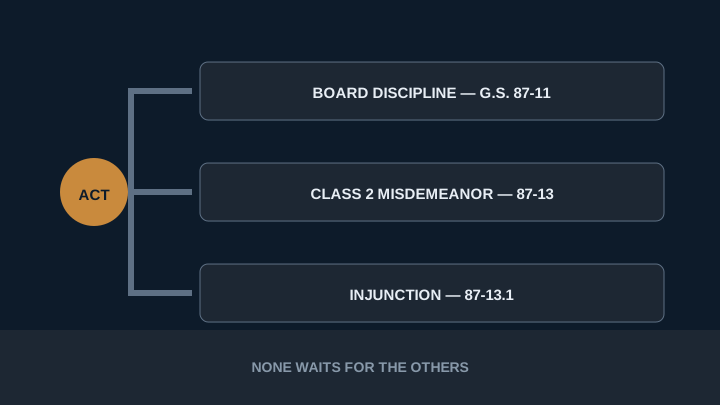
Exposure for a licensing failure runs on three separate tracks, and they operate independently. The first is administrative: the Board disciplining a licensee under G.S. 87-11. The second is criminal: a Class 2 misdemeanor under G.S. 87-13. The third is civil-injunctive: the Board going to superior court under G.S. 87-13.1 to stop a violation. None of them waits for the others. G.S. 87-13.1 says so expressly — the court has jurisdiction to grant relief irrespective of whether criminal prosecution has been instituted or administrative sanctions imposed. A contractor who assumes that beating one track disposes of the others has misread the structure.
Authority: N.C.G.S. § 87-11 · N.C.G.S. § 87-13 · N.C.G.S. § 87-13.1
What the Board can do, and on what grounds — 87-11(a)
The Board may refuse to issue or renew, revoke, suspend, or restrict a certificate of license, issue a reprimand, or take other disciplinary action, where a licensed general contractor is found guilty of fraud or deceit in obtaining a license, gross negligence, incompetency, or misconduct in the practice of the profession, or willful violation of any provision of the Article. Note how many verbs there are: the outcome is not binary between clean and revoked. Restriction and reprimand are live options, which matters when arguing proportionality at a hearing. The grounds themselves repay close reading too. “Gross negligence” and “incompetency” are about the practice of the profession, so they reach how work was performed; “misconduct” is given content by 21 NCAC 12A .0201(3), which defines it to include allowing an unlicensed person or entity to use a license or examination credential where a license is required, and allowing a licensed person to use one on an undertaking for which the user lacks the proper classification or limitation. Those two limbs make license-lending a disciplinary matter in its own right, independent of whether any work was done badly.
Authority: N.C.G.S. § 87-11 ·
The qualifier is separately exposed
The second sentence of 87-11(a) is the one qualifiers should read twice. The Board may revoke, suspend or otherwise restrict the ability of any person to act as a qualifying party for a license, for any copartnership, corporation, organization or combination, if that person committed any act in violation of the section — and the Board may separately take disciplinary action against that individual’s own license. So a qualifier can lose the capacity to qualify anyone, and be disciplined personally, out of the same conduct. Read alongside the four-year archive rule from Module 4, a qualifier’s credential is more fragile than most licensees assume.
Authority: N.C.G.S. § 87-11
How a charge travels — 87-11(a1) and the .0700 rules
Any person may prefer charges of fraud, deceit, negligence or misconduct against a licensee. The charges must be in writing and sworn to by the complainant. Unless the Board dismisses them without hearing as unfounded or trivial, they are heard and determined under Chapter 150B. 21 NCAC 12A .0701 fills in the machinery: the complaint goes to a staff investigator, the Board forwards written notice to the licensee and qualifier within 30 days through the licensure portal and by email, and after investigation a review committee — one Board member, the Secretary-Treasurer or designee, and an agreed staff person — recommends dismissal, acceptance of an admission with an order not to repeat, or a full-Board hearing. A matter may be resolved by consent order before it is heard.
Authority: N.C.G.S. § 87-11 ·
The first $5,000 — administrative costs under 87-11(e)
Where a licensee or qualifying party is found to have committed fraud or deceit in obtaining a license, gross negligence, incompetency or misconduct in the practice of general contracting, or a willful violation of the Article, the Board is entitled to recover its reasonable administrative costs associated with investigating and prosecuting the violation, up to a maximum of five thousand dollars ($5,000). This is a cost-recovery provision attached to a disciplinary finding, not a fine, and it sits on top of whatever sanction the Board imposes. Two practical points follow. It attaches to a finding, so it is not available where a charge is dismissed as unfounded or trivial; and because it tracks the Board’s actual reasonable costs, it grows with how hard the matter is fought.
Authority: N.C.G.S. § 87-11
Class 2 misdemeanor, and it is broader than unlicensed contracting — 87-13
G.S. 87-13 makes a Class 2 misdemeanor of considerably more than building without a license. It reaches contracting for or bidding upon enumerated work without having complied with the Article; attempting to practice general contracting outside the Article; presenting or attempting to file another’s license certificate as your own; giving false or forged evidence of any kind to the Board; falsely impersonating another; using an expired or revoked certificate; and falsely claiming or suggesting, in connection with regulated business activity, that a person or firm is licensed. Several of those are things an otherwise-licensed contractor can do.
Authority: N.C.G.S. § 87-13
The designer is exposed too
The same section reaches any architect or engineer who recommends to a project owner the award of a contract to anyone not properly licensed under the Article. That is a real and under-appreciated exposure on the design side. It comes with one safe harbor: no architect or engineer is guilty under the section if the recommendation to award was made in reliance upon current written information received from the appropriate Contractor Licensing Board of this State that erroneously indicated the contractor was properly licensed. The protection is for reliance on current, written, Board-sourced information — not on the contractor’s own assurance.
Authority: N.C.G.S. § 87-13
The second $5,000 — injunctions under 87-13.1
When the Board determines that a person, firm or corporation has violated or is violating the Article or the Board’s rules, it may apply to the superior court for a restraining order and injunction, and the superior courts have jurisdiction to grant that relief. Where the Board prevails, the court shall award it a reasonable attorney’s fee not to exceed five thousand dollars ($5,000), PLUS the costs associated with obtaining the relief and with the investigation and prosecution of the violation. 21 NCAC 12A .0702 is the route in: an unlicensed-practice complaint is investigated, and if the review committee finds probable cause it recommends that injunctive relief be sought.
Authority: N.C.G.S. § 87-13.1 ·
Two caps, two different things
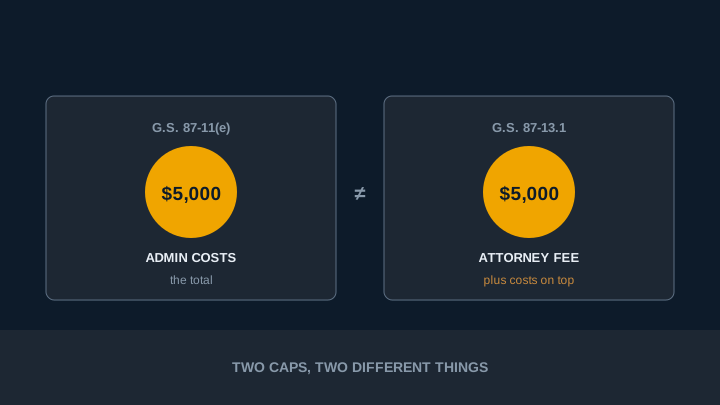
Both figures are five thousand dollars, and confusing them is easy. Under 87-11(e) the $5,000 caps the Board’s ADMINISTRATIVE COSTS in a disciplinary matter against a licensee or qualifying party. Under 87-13.1 the $5,000 caps the ATTORNEY’S FEE the court awards the Board in a successful injunction action — and the costs of obtaining relief and of investigation and prosecution are awarded on top of it, not inside it. Different proceeding, different party, different item capped, and in the injunction case the total recovery is not limited to $5,000.
Authority: N.C.G.S. § 87-11 · N.C.G.S. § 87-13.1
Traducción de cortesía — la versión en inglés es la oficial del curso.
Tres vías, no una
La exposición por una falla de licencia corre por tres vías separadas, y operan de forma independiente. La primera es administrativa: la Junta sancionando a un licenciatario bajo la G.S. 87-11. La segunda es penal: un delito menor Clase 2 bajo la G.S. 87-13. La tercera es civil-cautelar: la Junta acudiendo a la superior court bajo la G.S. 87-13.1 para detener una infracción. Ninguna espera a las otras. La G.S. 87-13.1 lo dice expresamente — el tribunal tiene jurisdicción para conceder el remedio con independencia de si se ha iniciado un proceso penal o se han impuesto sanciones administrativas. El contratista que supone que ganar en una vía resuelve las demás ha leído mal la estructura.
Qué puede hacer la Junta, y sobre qué fundamentos — 87-11(a)
La Junta puede negarse a emitir o renovar, revocar, suspender o restringir un certificado de licencia, emitir una reprimenda, o tomar otra acción disciplinaria, cuando se halle a un contratista general licenciado culpable de fraude o engaño en la obtención de una licencia, de negligencia grave, de incompetencia o de conducta indebida en el ejercicio de la profesión, o de violación intencional de cualquier disposición del Artículo. Note cuántos verbos hay: el resultado no es binario entre limpio y revocado. La restricción y la reprimenda son opciones vivas, lo cual importa al argumentar proporcionalidad en una audiencia. Los fundamentos mismos también premian una lectura atenta. La “negligencia grave” y la “incompetencia” se refieren al ejercicio de la profesión, de modo que alcanzan cómo se ejecutó la obra; la “conducta indebida” recibe su contenido de la 21 NCAC 12A .0201(3), que la define de modo que incluye permitir que una persona o entidad sin licencia use una licencia o una credencial de examen donde se requiere licencia, y permitir que una persona licenciada use una en una obra para la cual quien la usa carece de la clasificación o la limitación adecuadas. Esas dos ramas hacen del préstamo de licencia un asunto disciplinario por derecho propio, con independencia de si algún trabajo se ejecutó mal.
El qualifier queda expuesto por separado
La segunda oración de la 87-11(a) es la que los qualifiers deberían leer dos veces. La Junta puede revocar, suspender o restringir de otro modo la capacidad de cualquier persona de actuar como parte calificadora de una licencia, para cualquier copartnership, corporación, organización o combinación, si esa persona cometió algún acto en violación de la sección — y la Junta puede, por separado, tomar acción disciplinaria contra la licencia propia de ese individuo. Es decir: un qualifier puede perder la capacidad de calificar a nadie, y ser sancionado personalmente, a partir de una misma conducta. Leída junto a la regla del archivo a los cuatro años del Módulo 4, la credencial de un qualifier es más frágil de lo que la mayoría de los licenciatarios supone.
Cómo viaja una acusación — 87-11(a1) y las reglas .0700
Cualquier persona puede formular cargos de fraude, engaño, negligencia o conducta indebida contra un licenciatario. Los cargos deben constar por escrito y ser jurados por el denunciante. Salvo que la Junta los desestime sin audiencia por infundados o triviales, se oyen y resuelven conforme al Capítulo 150B. La 21 NCAC 12A .0701 completa la maquinaria: la queja pasa a un investigador del personal, la Junta remite aviso escrito al licenciatario y al qualifier dentro de 30 días a través del portal de licencias y por correo electrónico, y tras la investigación un comité de revisión — un miembro de la Junta, el Secretary-Treasurer o su designado, y un funcionario acordado — recomienda la desestimación, la aceptación de una admisión con una orden de no reincidir, o una audiencia ante la Junta en pleno. Un asunto puede resolverse por consent order antes de ser oído.
El primer $5,000 — costos administrativos bajo la 87-11(e)
Cuando se halla que un licenciatario o una parte calificadora cometió fraude o engaño en la obtención de una licencia, negligencia grave, incompetencia o conducta indebida en el ejercicio de la contratación general, o una violación intencional del Artículo, la Junta tiene derecho a recuperar sus costos administrativos razonables asociados a investigar y perseguir la infracción, hasta un máximo de cinco mil dólares ($5,000). Es una disposición de recuperación de costos adherida a un hallazgo disciplinario, no una multa, y se suma a cualquier sanción que la Junta imponga. De ahí se siguen dos puntos prácticos. Se adhiere a un hallazgo, así que no procede cuando un cargo se desestima por infundado o trivial; y como sigue los costos razonables efectivos de la Junta, crece con lo duro que se litigue el asunto.
Delito menor Clase 2, y alcanza más que contratar sin licencia — 87-13
La G.S. 87-13 tipifica como delito menor Clase 2 considerablemente más que construir sin licencia. Alcanza contratar u ofertar sobre la obra enumerada sin haber cumplido con el Artículo; intentar ejercer la contratación general fuera del Artículo; presentar o intentar presentar el certificado de licencia de otro como propio; dar a la Junta evidencia falsa o falsificada de cualquier clase; hacerse pasar falsamente por otro; usar un certificado vencido o revocado; y afirmar o sugerir falsamente, en conexión con actividad comercial regulada, que una persona o firma está licenciada. Varias de esas cosas son cosas que puede hacer un contratista que por lo demás sí está licenciado.
El diseñador también queda expuesto
La misma sección alcanza a cualquier arquitecto o ingeniero que recomiende al propietario de un proyecto adjudicar un contrato a alguien que no esté debidamente licenciado bajo el Artículo. Esa es una exposición real y poco apreciada del lado del diseño. Viene con un puerto seguro: ningún arquitecto o ingeniero es culpable bajo la sección si la recomendación de adjudicar se hizo confiando en información escrita vigente recibida del Contractor Licensing Board correspondiente de este Estado que indicaba erróneamente que el contratista estaba debidamente licenciado. La protección es por confiar en información vigente, escrita y proveniente de la Junta — no en la propia palabra del contratista.
El segundo $5,000 — medidas cautelares bajo la 87-13.1
Cuando la Junta determina que una persona, firma o corporación ha violado o está violando el Artículo o las reglas de la Junta, puede solicitar a la superior court una orden de restricción y una medida cautelar, y las superior courts tienen jurisdicción para concederla. Cuando la Junta prevalece, el tribunal le adjudicará honorarios de abogado razonables que no excedan cinco mil dólares ($5,000), MÁS los costos asociados a obtener el remedio y a la investigación y persecución de la infracción. La 21 NCAC 12A .0702 es la vía de entrada: una queja por ejercicio sin licencia se investiga, y si el comité de revisión halla causa probable recomienda que se busque el remedio cautelar.
Dos topes, dos cosas distintas
Ambas cifras son cinco mil dólares, y confundirlas es fácil. Bajo la 87-11(e) los $5,000 topan los COSTOS ADMINISTRATIVOS de la Junta en un asunto disciplinario contra un licenciatario o una parte calificadora. Bajo la 87-13.1 los $5,000 topan los HONORARIOS DE ABOGADO que el tribunal adjudica a la Junta en una acción cautelar exitosa — y los costos de obtener el remedio y los de investigación y persecución se adjudican por encima de ellos, no dentro. Procedimiento distinto, parte distinta, rubro topado distinto, y en el caso cautelar la recuperación total no está limitada a $5,000.
Authority & state references
- N.C.G.S. § 87-11 — Revocation of license; charges of fraud, negligence, incompetency, etc.; hearing thereon; reissuance of certificate ⏱ ≈ 4 min read
- N.C.G.S. § 87-13 — Unauthorized practice of contracting; penalties ⏱ ≈ 3 min read
- N.C.G.S. § 87-13.1 — Board may seek injunctive relief; attorney's fee ⏱ ≈ 2 min read
- — Definitions — subsection (3) ⏱ ≈ 2 min read
- — Improper Practice ⏱ ≈ 3 min read
- — Unlicensed Practice ⏱ ≈ 3 min read
Tap any citation to read it in the statute reader without leaving this page — about 17 minutes of authority reading is available in this module. Time spent here is instructional time: use it if you want more depth, or if you need additional minutes toward the 200-minute course requirement.
Official text opens on the North Carolina General Assembly site (ncleg.gov) — the source of record for every citation. Read-time figures are estimates.
Independent contractor-education provider. Not affiliated with, endorsed by, or acting for the North Carolina Licensing Board for General Contractors. Education, not legal advice — verify current statutes with the NC General Assembly.